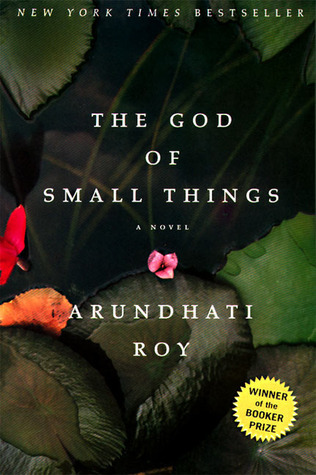
The need for conversion may have arisen from prejudice, I confess. On reading an interview with the author recently – who has just published her second book after 20 years – I was reminded that ‘The God of Small Things’ was on my bucket list to read; one of many, it must be said. I found the interview intriguing and immediately obtained a copy of the book.
I don’t think I’ve experienced such a conversion experience – last minute, at that – as I have with Arundhati Roy’s first (and until recently, only) novel.
The novel – which details the lives of Ammu and her twin children, and the tragedy which is to change their world forever – is, in many ways, typical of fiction coming out of India over the last few decades. Entirely realistic yet wholly philosophical, Roy’s well-crafted words present a journey as smooth as floating down a river on a breezy sunny day; an appropriate and ironic metaphor considering the events which will take place.
I was convinced from the interview and from the book that Roy is quite, quite insane. Not ‘run around naked’ mad; a quiet but definite eccentricity to the point of no longer being quaint kind of insanity. It wasn’t an amusing madness either. She’s not my cup of tea as a human being nor as an author. I found her disturbing, if not dangerous.
For at least three-quarters of the book I held this opinion, wondering as I read if this would be a three-star or possibly, at a stretch, a four-star review. Her turn of phrases, whilst mildly annoying in their repetitiveness, were nonetheless rather beautiful. It is undoubtedly well written. Other aspects though were trying. While mixing up chronology of a story and narrator omniscience is nothing new in literature, the current fixation of the last few decades of post-modernist writers to do this is beginning to be as clichéd as their romantic novelist precursors swiftly became long ago. Roy does this to extremes.
She not just hints of the story to come but jolly well gives so much of the plot away that by the time we come to the incidents themselves we already know pretty much all but the tiniest of details. The moments come as an anticlimax then and this can somewhat spoil the enjoyment. At the same time, the coldness of the characters failed to move me. I was not going to miss them once they were gone, I felt.
And then, Damascus road-like, in the last few chapters, Roy brings it all together. It is not the incidents that matter, not even the aftermath. It is the incident after the incidents which changes everything. ‘How everything can change in a day’ goes one of the recurring motifs in Roy’s book; how everything can change in a chapter too.
I came away, glowing and bleary-eyed at the end. Now the twins, who are the centre of this whirling wheel of action and emotion, matter to me, lost at the end of the final page just as I’d finally found them. Like a brilliant whodunnit but without the murder mystery, I back-pedalled over all that had occurred since the beginning of the book now I understood not the events (they were signposted almost from the beginning) but heart of the matter. That changes everything. What was annoying, became brilliant. What was unimportant became life-changing.
And so I stand converted. Gone from thinking that this was just a well-worded novel, challenging (Indian) social values, but lacking real depth, to wanting to read it from the beginning to taste these characters again. This I won’t do; I rarely reread a book and when I do I make sure there are many years intervening – otherwise there is nothing new to benefit and too much danger of exorcising beloved ghosts. Instead, I’ve done the next best thing: I’ve bought Roy’s new book, ‘The Ministry of Utmost Happiness’. I will sit, like a pupil at his new guru’s feet, and drink in her words.
Do I still think she’s mad? Oh yes, of that I have no doubt. But there is a beauty and a clarity in some kinds of madness which allows you to see the world through a sharper lens. It has been said so often before that it is actually the world which is insane, not the insane themselves. It’s a cliché. But sometimes, when clichés are used so much they become motifs, there is a transformation and the familiar becomes a stranger to be discovered all over again. Such is Arundhati Roy’s legacy.
My verdict:

Social Entrepreneur, educationalist, bestselling author and journalist, D K Powell is the author of the bestselling collection of literary short stories “The Old Man on the Beach“. His first book, ‘Sonali’ is a photo-memoir journal of life in Bangladesh and has been highly praised by the Bangladeshi diaspora worldwide. Students learning the Bengali language have also valued the English/Bengali translations on every page. His third book is ‘Try not to Laugh’ and is a guide to memorising, revising and passing exams for students.
Both ‘The Old Man on the Beach’ and ‘Sonali’ are available on Amazon for kindle and paperback. Published by Shopno Sriti Media. The novel,’The Pukur’, was published by Histria Books in 2022.
D K Powell is available to speak at events (see his TEDx talk here) and can be contacted at dkpowell.contact@gmail.com. Alternatively, he is available for one-to-one mentoring and runs a course on the psychology of writing. Listen to his life story in interview with the BBC here.
Ken writes for a number of publications around the world. Past reviewer for Paste magazine, The Doughnut, E2D and United Airways and Lancashire Life magazine. Currently reviews for Northern Arts Review. His reviews have been read more than 7.9 million times.
Get a free trial and 20% off Shortform by clicking here. Shortform is a brilliant tool and comes with my highest recommendation.


 Write Out Loud (Reviews and Writing)
Leave a comment