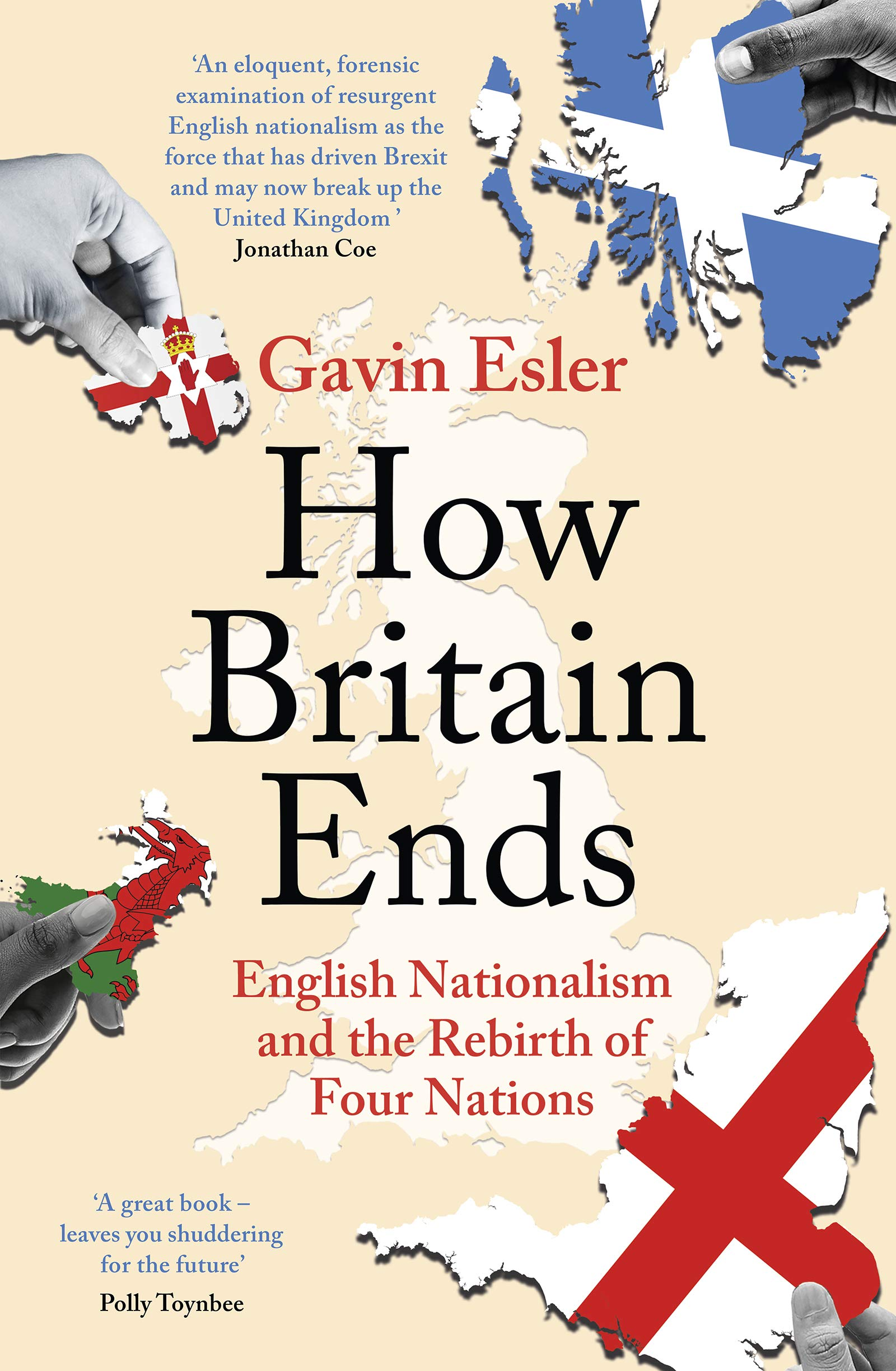
This is a fascinating book written by a well-respected and established journalist who has his own roots in three out of the four nations that make up the so-called ‘United’ Kingdom. That the kingdom is anything but united is the very point of Esler’s book. He sees the end of the union coming soon. He’s not the only political commentator who thinks this.
Much of this prediction is, of course, centred around Brexit – which immediately raises the heckles of all Brexshitters and not a few of them have given poor customer reviews on various sites. Even the more learned and academically talented of those still reject any criticism of Brexit and its effects and go for the tired and boring personal attacks on the author rather than present any reasoned defence of a different position. For everyone else, this is a really thought-provoking book.
Disclaimer: in case you hadn’t already guessed it, I am definitely a remoaner/rejoiner (yes, I like remoaner because I bloody well will moan to all those who voted leave about what they’ve done to this country and no, I don’t forgive or forget). But while I will point the finger of blame strongly out of a sense of justice, I gave up on this silly English nation years ago, so I’m not really a staunch remainer. The words ‘petard’ and ‘hoist’ come firmly to mind in this respect. I couldn’t care less what happens to us all now – I’m just permanently angry. That said, I am confident that, eventually, it will all settle down and our economy and life will improve – but only back to some form of what it was before 2016; it’s an absolute shot in the foot – or perhaps even the knee or thigh. We’ll always limp, but things have a habit of balancing out eventually.
This is all fine as a background, but while much of Esler’s hypothesis rests on the results of Brexit and the deep divisions it has caused, it is only as the ‘straw that breaks’ as far as Esler is concerned. The damage to the union has been going on for decades and even centuries, he claims. I don’t think he’s wrong.
Esler presents a strong argument for claiming that nationalism is behind the current surge in the direction of both Northern Irish and Scots wanting independence (and arguably Welsh too). But it isn’t their nationalism he’s talking about: it’s English nationalism. He’s absolutely on the nail here. The English have never given up their colonial instincts and superior elitism. We like to pretend we’re the fairest, most welcoming, tolerant and non-judgemental of people. The truth is, we’re anything but those things and we’ve always told ourselves these lies. Esler points out that this extends as far as using the term ‘British’. There’s nothing British about being British. We mean English almost every single time and the other nations are, understandably, getting annoyed about it. Who can blame them when we have such abhorrent extremist behaviours which are now so commonplace white English people don’t bother to hide it much any longer? We really don’t represent who the Scots, Welsh or Irish are. We never have.
Esler is a writer like Harari, for me: he writes what I was already thinking but hadn’t put into words in such succinct ways. For years I’ve called myself English first, British second. Actually, scratch that. I’ve called myself English first, European second, father, husband, writer, teacher…almost anything else next…and British last of all as, technically, I can’t avoid it as a truth at least legally. But I’ve never felt it exists in reality. Esler gives it a name.
Given what I’ve been saying it may seem odd that I call myself English first – as those that do are almost inevitably nationalists. But I hold it as a truth. There is no ‘British’ any any moral or ethnological way. I’m English and I like being English for the few – but very special – things that make us so (some of which we do indeed share with our neighbours). I like English pubs. I like our vast countryside. I like our classical music and our great writers. I like Wimbledon. I like how we queue! I love our sense of humour. All this is good stuff. I just don’t like our ‘we’re better than everyone else and we’re the only ones who are hard-working and honest’ crap we believe to our very core. For Esler, everyone is fed up of it and it will see the breakdown of the union. Brexit makes it no longer a viable option to stay together. Indeed, the Irish border problem is unlikely to ever be solved without a united Ireland.
But, in the final analysis, I think Esler it wrong. I don’t think the union is going to come to an end – not unless something even more catastrophic comes along. And that’s because, despite everything he says being really very true, he’s not accounted for the one thing we might just call ‘British’: inertia.
We claim a history that avoided bloody revolutions (it’s not entirely true either but lets roll with it for now); when the French and Russians etc. were all busy killing each other, the ‘British’ made changes largely peacefully and kept a government together than can trace a recognisable form back to at least Elizabethan England, if not before. Why? I think because of inertia. We will moan and complain about things changing and/or being bad (the two are often confused) but we will tolerate them for a considerable length of time. It takes a lot to push us to the edge.
It is the same now. Brexit, effectively, happened seven years ago at the time of writing. It came into force properly two years ago. We’ve gone though multiple prime ministers and even the Scottish parliament has had a changeover with Sturgeon’s reputation currently in tatters. As the face of the Scottish referendum, this means the taste for independence has diminished. We’re going through the worst financial crisis since 2008 and we never actually got over the last one. More than decade of tory misrule – some of it borderline criminal – and we still haven’t rioted on the streets, metaphorically or otherwise. The Brits grumble and moan, but we don’t do anything about it. That’s exactly what I’m doing now. And once finished with this, I’ll go make myself a cup of tea and be satisfied (that’s another English thing I like!).
As I said earlier, I think things will balance out. We will come out of our near-recession. Businesses will find new ways to survive in a post-Brexit world. The economy will, eventually, stagger into something half decent. And with each passing day, week, month and year, we’re less and less likely to think things are bad enough to warrant splitting up. It really will take a return to ‘the troubles’ or something of that ilk to threaten that. Without a crisis (and I mean a real whopper because we’re all already totally ‘crisised out’) the union will stagger on. Better the devil you know and all that – even if he’s white and English.

Social Entrepreneur, educationalist, bestselling author and journalist, D K Powell is the author of the bestselling collection of literary short stories “The Old Man on the Beach“. His first book, ‘Sonali’ is a photo-memoir journal of life in Bangladesh and has been highly praised by the Bangladeshi diaspora worldwide. Students learning the Bengali language have also valued the English/Bengali translations on every page. His third book is ‘Try not to Laugh’ and is a guide to memorising, revising and passing exams for students.
Both ‘The Old Man on the Beach’ and ‘Sonali’ are available on Amazon for kindle and paperback. Published by Shopno Sriti Media. The novel,’The Pukur’, was published by Histria Books in 2022.
D K Powell is available to speak at events (see his TEDx talk here) and can be contacted at dkpowell.contact@gmail.com. Alternatively, he is available for one-to-one mentoring and runs a course on the psychology of writing. Listen to his life story in interview with the BBC here.
Ken writes for a number of publications around the world. Past reviewer for Paste magazine, The Doughnut, E2D and United Airways and Lancashire Life magazine. Currently reviews for Northern Arts Review. His reviews have been read more than 7.9 million times.
Get a free trial and 20% off Shortform by clicking here. Shortform is a brilliant tool and comes with my highest recommendation.

Social Entrepreneur, educationalist, bestselling author and journalist, D K Powell is the author of the bestselling collection of literary short stories “The Old Man on the Beach“. His first book, ‘Sonali’ is a photo-memoir journal of life in Bangladesh and has been highly praised by the Bangladeshi diaspora worldwide. Students learning the Bengali language have also valued the English/Bengali translations on every page. His third book is ‘Try not to Laugh’ and is a guide to memorising, revising and passing exams for students.
Both ‘The Old Man on the Beach’ and ‘Sonali’ are available on Amazon for kindle and paperback. Published by Shopno Sriti Media. The novel,’The Pukur’, was published by Histria Books in 2022.
D K Powell is available to speak at events (see his TEDx talk here) and can be contacted at dkpowell.contact@gmail.com. Alternatively, he is available for one-to-one mentoring and runs a course on the psychology of writing. Listen to his life story in interview with the BBC here.
Ken writes for a number of publications around the world. Past reviewer for Paste magazine, The Doughnut, E2D and United Airways and Lancashire Life magazine. Currently reviews for Northern Arts Review. His reviews have been read more than 7.9 million times.
Get a free trial and 20% off Shortform by clicking here. Shortform is a brilliant tool and comes with my highest recommendation.


 Write Out Loud (Reviews and Writing)
Leave a comment