“…we always look back to a time that didn’t exist.”
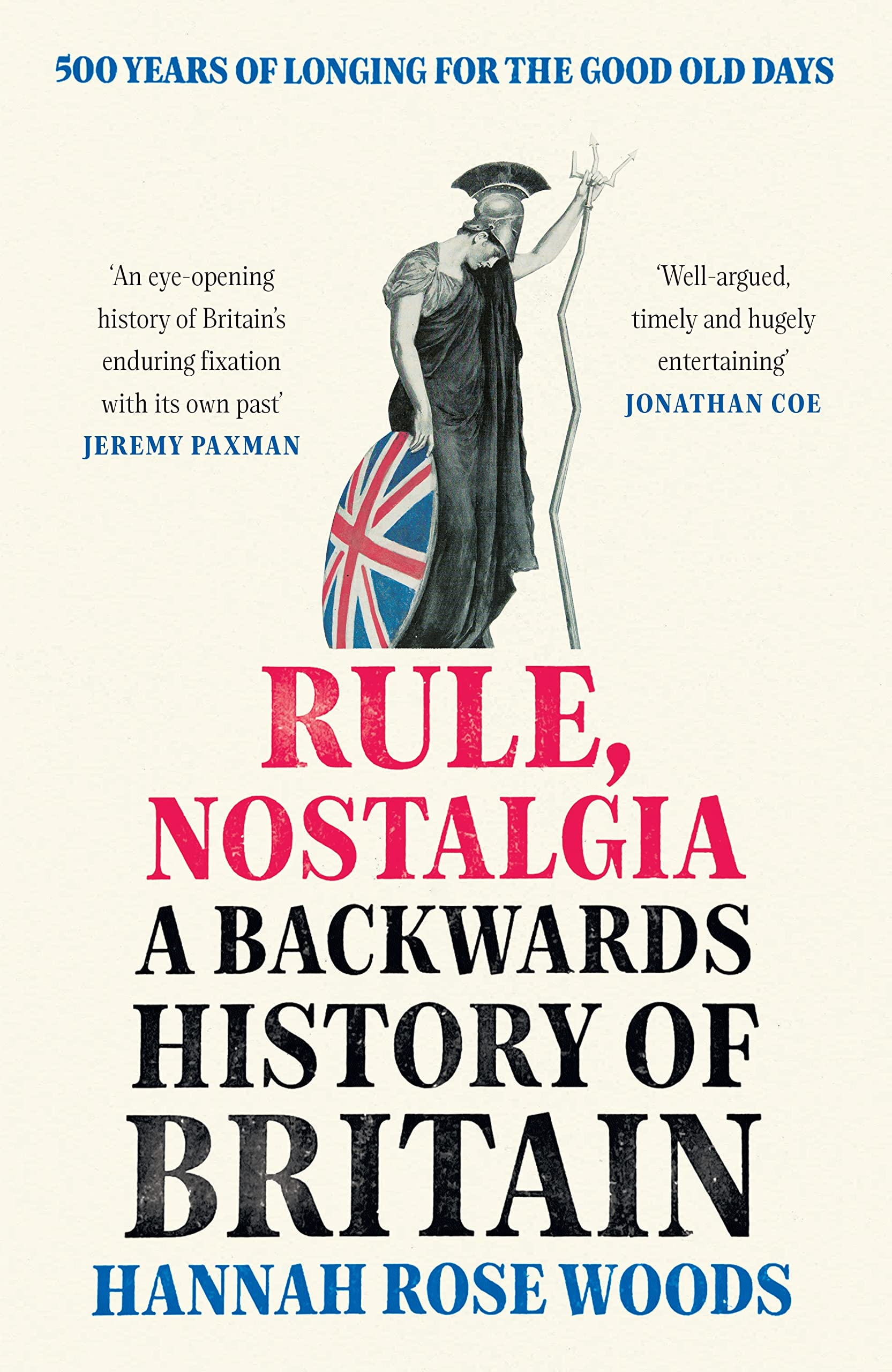
Hannah Rose Woods has crafted a superb book that entertains as much as it does illuminates and does so without trying to be witty or find some forced clever idea that doesn’t work. Instead, she writes with the absolute precision you’d expect from an historian. Deeper meanings (if there are any) you have to glean for yourself.
What IS clever – genuinely so – is the premise that the very nature of nostalgia, that of looking back to the past, should be the way to write the book: backwards.
Woods starts in the present, looking at our own very British version of the MAGA phenomenon and the continual call to make Britain great again, return to post-war values etc. Then she goes back to Thatcher’s time, then back to the time of the world wars; and so on, until we get as far back as the Tudor period where she arbitrarily stops. It’s clear she could continue, but the point is made: we always look back to a time that didn’t exist.
I’m not sure this is a peculiarly British thing to do and Woods does raise this point in part. I suspect it is the nature of all human social groups to have a degree of rose-tinted specs for the half-remembered past. And further back we all get fed the romanticism of times before our grandparents via movies, books and, occasionally, historical sources too.
But Woods focuses on the British, I think, not just because it is British history in which she has expertise, but because of a point briefly raised at the end of her book. There she posits that the British love to look back on a falsely portrayed past precisely because it is false portrayed. We revel in reinvention.
It is hard to deny this as history shows us doing this again and again. The Renaissance, Peter Frankopan points out in his brilliant book, The Silk Roads, is really a ‘naissance’. We invented a classical past for ourselves. Henry VIII and his advisors (Wolsey etc) invented an English history and theology that allowed him to pull away from papal Rome. This seems to be the nature of the English. When we want something, we change our history to make it always so.
Is this a bad thing? Woods avoids saying it, preferring to let the voices of the past do the talking as much as possible. Nevertheless, I would be surprised if I found she was an immigrant-hating, Brexit-loving tory. There’s more than enough vibes that she looks disparagingly on the vociferous right wingers whinging away on social media day after day. If so, I agree with her. I’m all for looking to the past fondly – I do it often as I recall such happy times half a century ago. But when doing so gives rise to hatred towards others, I find it all rather bitter.
Britain is not very good at looking at itself honestly. We jingo ourselves up and blag our way through every criticism with the swagger of a Boris Johnson. The result is often the immense suffering of other people. It’s not nice and when we are faced with it, we retreat into fantasies all the more and dismiss the claims. Woods book is a timely reminder that we British have a long history of doing this. It is more than time for us to change.
My Verdict:

Social Entrepreneur, educationalist, bestselling author and journalist, D K Powell is the author of the bestselling collection of literary short stories “The Old Man on the Beach“. His first book, ‘Sonali’ is a photo-memoir journal of life in Bangladesh and has been highly praised by the Bangladeshi diaspora worldwide. Students learning the Bengali language have also valued the English/Bengali translations on every page. His third book is ‘Try not to Laugh’ and is a guide to memorising, revising and passing exams for students.
Both ‘The Old Man on the Beach’ and ‘Sonali’ are available on Amazon for kindle and paperback. Published by Shopno Sriti Media. The novel,’The Pukur’, was published by Histria Books in 2022.
D K Powell is available to speak at events (see his TEDx talk here) and can be contacted at dkpowell.contact@gmail.com. Alternatively, he is available for one-to-one mentoring and runs a course on the psychology of writing. Listen to his life story in interview with the BBC here.
Ken writes for a number of publications around the world. Past reviewer for Paste magazine, The Doughnut, E2D and United Airways and Lancashire Life magazine. Currently reviews for Northern Arts Review. His reviews have been read more than 7.9 million times.
Get a free trial and 20% off Shortform by clicking here. Shortform is a brilliant tool and comes with my highest recommendation.


 Write Out Loud (Reviews and Writing)
Leave a comment