“…Hyam’s book has not aged too well.”
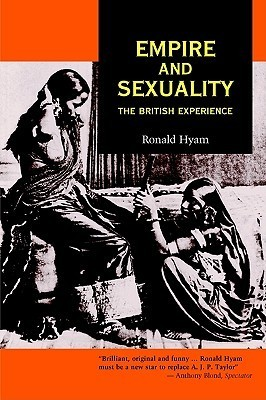
I can’t remember when or where I first heard about this book. It certainly wasn’t a personal recommendation. No one I know would even conceive that such a book exists at all! I’m fairly certain it was a reference I came across while reading something completely different online. It was probably mentioned in passing or as a citation. It is exactly the kind of thing that would stop me in my tracks, make me say “no way!” to myself and then go buy it on Amazon before then returning to whatever text it was I was reading in the first place. Yes, I am a sucker for shopping in this way (at least when it comes to off-the-wall books).
The book then sat on my (rather extensive) to-read pile for at least a couple of years. It was only after moving home and now having a place much more conducive for reading (and writing for that matter) that I decided to open the academic tome and get started.
The book describes itself as a “lively study of the sexual attitudes of the men who ran the British Empire” and aims to show that the Empire was built not just on religion and commerce but also the needs for sexual gratification among the British servants of the Empire. That such a book could be written at all was a surprise to me. I didn’t think there would be much in the records of the private affairs of officials in strait-laced Victorian society; but I was wrong.
The first thing to note is that this book was published in 1991. A lot has changed in that time. It is still bizarre for me to think that a) I was twenty back then and b) it was 33 years ago. Both should be obvious but my brain makes me forget to save me from despair. When this book published I had not yet begun my professional career as a teacher and what I knew about the Empire you could write on the back of a stamp.
Like I say. A lot has changed since then.
Unfortunately, this means that Hyam’s book has not aged too well. There is more than a strong hint of ‘pro-Empire’ about the way he phrases things and especially about the way he ‘excuses’ some of the exploits of British officers in service abroad that, today, we would call out for what they are: paedophilia and sexual abuse.
He’s also not a fan of feminism, dismissing such analysis as, at best, ‘primitive’ and largely sees it as irrelevant because his work focuses ‘on the attitudes and activities of the men who ran the empire’. That Hyam can’t see the irony of this thinking says a lot about the mentality of the day. These men, who used and abused woman (as well as boys) throughout the empire, ruled with a paternalistic ideology that saw themselves as the gatekeepers to the civilised world and bearing ‘the white man’s burden’. If you can’t see at least the interest in a feminist critique here, there’s something very wrong. Hyam is clear that he doesn’t value in a discipline he sees as automatically hostile towards one gender. To say this is blinkered is an understatement.
It is also a great pity. This book would have been so much better had space been given to any female perspective in any form. This is especially important considering how often Hyam justifies the actions of several men who were punished for their indiscretions, by claiming that they had followed ‘honourable’ traditions in villages and bought their concubines in perfectly acceptable ways. These ‘honourable ways’ turn out to be negotiating the temporary bride price with the fathers of the women of interest. Hyam more than suggests this meant all was perfectly fine from a contemporary point of view. It isn’t, of course. What did the women themselves think? There is at least one case of a young woman who was pursued and repeatedly rejected the man’s advances but was in the end made to become his concubine as a result of deals made with her father. While I know that things are done differently in many parts of the world, they weren’t done like this in England even at that time (unless you were royalty, of course). That the woman usually had no say in the matter is repulsive. That Hyam makes no comment on this is almost equally so.
Instead, he picks up more on the reasons for some men being punished: defiling the Empire. It was believed that mixed race children would bear ‘the worst traits of both races’ and it was disgusting that white men should even consider having sexual relations with women of colour. To be fair, Hyam is not wrong to pick up on this. It is a ghastly thought that this was the common thinking of English people for so long. No wonder the vestiges are still here in society today. More worrying is that such thinking is beginning to make a come back.
Another crime of Hyam’s, is that he consistently passes over, without comment, the activities themselves – of which there are many cited. While he details what men wrote in their diaries about conquests with young boys (including how many times climax was achieved etc.) he makes no comment at all about the fact that many sexual conquests were girls and boys who were not even in their teens. Again, I appreciate we lived in different times then and even in my lifetime I’ve seen a shift in society’s views. When I was young, famous men having teenage girlfriends under the age of sixteen was just passed over in silence – if not admiration. The Prince Andrew scandals, et al, should not just be the condemnation of such men but also a tacit condemnation of society itself that approved of such things. But Hyam doesn’t go there. If anything, there’s whiffs of dislike that such men engaged in homosexual activities (also a bad thing!), but nothing at all about the rights and wrongs of taking boys against their will and having sex with them.
What Hyam does show, however, is that such activities were rife. When attempts were made to wipe out concubinage and prostitution across the empire, it was met with great resistance because it was so widespread, officials feared they’d lose men if licence wasn’t given. Most of the time it had been a case of: as long as you don’t bring scandal to the empire and you don’t cause the natives to riot, what you do behind locked doors is up to you.
Perhaps the most fascinating idea presented though is this: Sex is at the very heart of racism – at least during the empire days. Hyam posits that racists views around the world were effectively ranked according to the attractiveness of native women. The idea that colonially racist views were graded according to the attractiveness of the women in any particular country is eye-opening to say the least.
It is an astonishing hypothesis but one I find difficult to fault. I can see great parallels to English racism today albeit that tastes have changed. In empire days, African women were seen as ugly but Japanese women were exquisite. Is it any coincidence that the western world continues to largely ignore Africa today while Japan became the best Asian friend of the west within years of the end of WWI despite Hiroshima and all that? Today though, the black woman is often seen as a goddess of beauty whereas the veiled Muslim woman (nothing but walking letterboxes, as Boris Johnson famously jibed) is derided and feared.
Another eye-opener was the idea that race relations in the Empire deteriorated according to the size the subjugated cock. The smaller statured Asian man, it seems, was better liked for being no rival for the affections of white women. However, the African man, with his reputation (deserved or otherwise) of great physical prowess in that region, was very much not liked by the British Imperial. Again, there is much mileage in this hypothesis. Outside of the Islamic terrorist rhetoric that is a fairly recent invention, Asian men have generally been seen as harmless and feeble by blinkered western minds. But the stats that a black man in London is nine times more likely to be stopped by Police and searched for weapons is well known. Why do we fear the black male community so much? Can such racism come down to the White man’s shame of his supposed cock size?
It is definitely a thought-provoking theory and for that reason, Hyam’s book is redeemed a little for its omissions and blinkered outlooks. There’s material of use here even if the author tells us as much about his own views as he does about empire history. I suspect this book will remain in the canon of academic material as I doubt there are many books on this subject out there. If there are others, I’m not sure I need to read them. I was fascinated by the concept of such a book and wanted to know what written archival material exists, but my thirst for such knowledge is quenched. Anything further would surely just be the equivalent of a peeping tom. And I find myself coming back to the fact that maybe these boys, girls, men and women who were the subjects of the British Empire have suffered more than enough. Time to leave them in silence.
My Verdict:
You can buy me a coffee if you like! More accurately, you can help support my work either as a one off or monthly if you really want to show your love…

Social Entrepreneur, educationalist, bestselling author and journalist, D K Powell is the author of the bestselling collection of literary short stories “The Old Man on the Beach“. His first book, ‘Sonali’ is a photo-memoir journal of life in Bangladesh and has been highly praised by the Bangladeshi diaspora worldwide. Students learning the Bengali language have also valued the English/Bengali translations on every page. His third book is ‘Try not to Laugh’ and is a guide to memorising, revising and passing exams for students.
Both ‘The Old Man on the Beach’ and ‘Sonali’ are available on Amazon for kindle and paperback. Published by Shopno Sriti Media. The novel,’The Pukur’, was published by Histria Books in 2022.
D K Powell is available to speak at events (see his TEDx talk here) and can be contacted at dkpowell.contact@gmail.com. Alternatively, he is available for one-to-one mentoring and runs a course on the psychology of writing. Listen to his life story in interview with the BBC here.
Ken writes for a number of publications around the world. Past reviewer for Paste magazine, The Doughnut, E2D and United Airways and Lancashire Life magazine. Currently reviews for Northern Arts Review. His reviews have been read more than 7.9 million times.
Get a free trial and 20% off Shortform by clicking here. Shortform is a brilliant tool and comes with my highest recommendation.


 Write Out Loud (Reviews and Writing)
Leave a comment