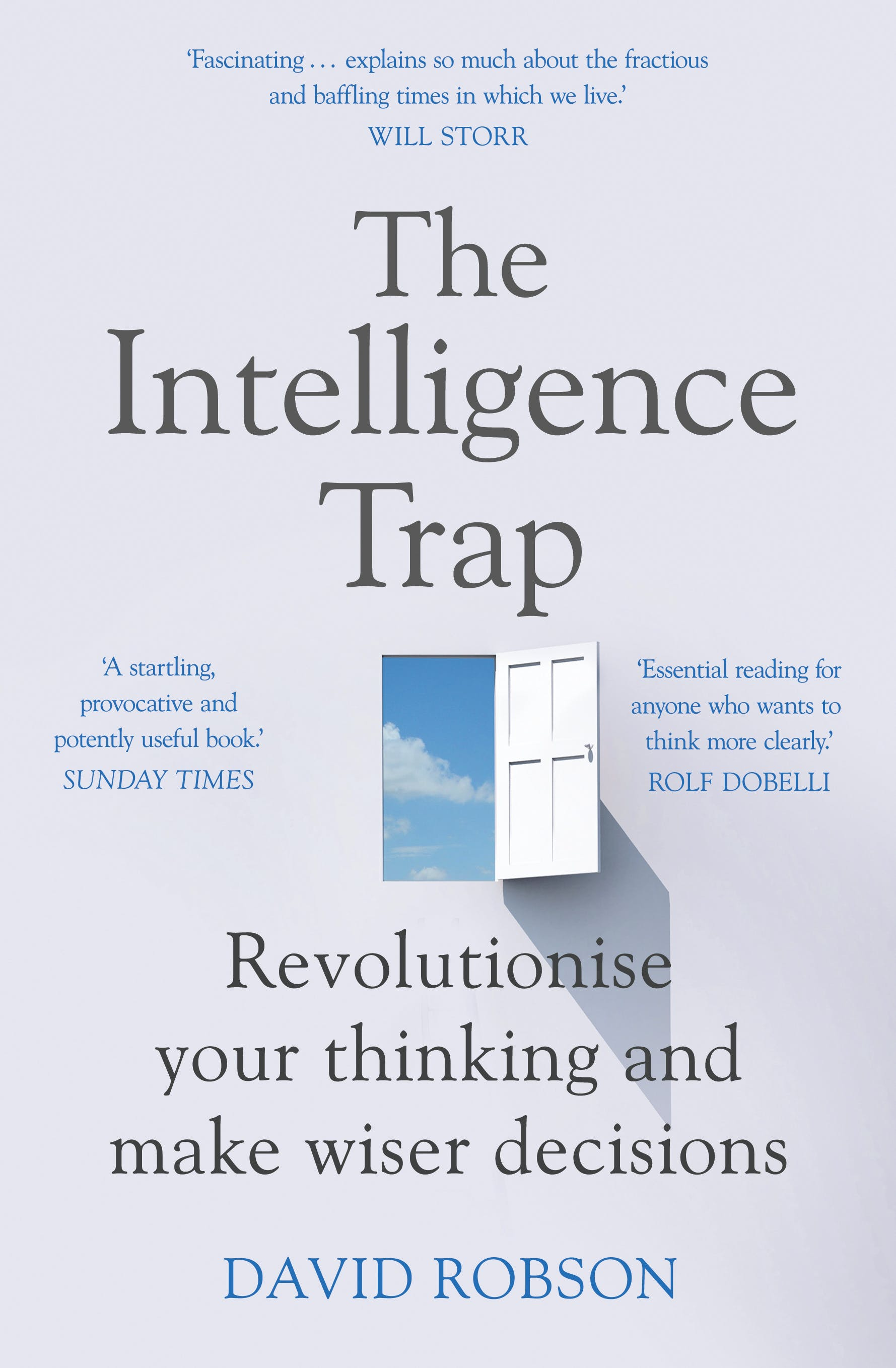
“…tons of great research…yet somehow fails to present a convincing or even coherent solution.”
I’ve had a very nerdy set of waves of emotions hit me while reading this book. It’s been a rollercoaster ride, I have to say. It started well, it didn’t end so good.
It sounds a little odd to say this about a non-fiction book, but this book started so well I was hooked within two pages of the introduction. Robson brilliantly shocked me by talking about a guy called Kary who is, quite obviously, an uneducated loon. Except that he isn’t – Kary is very far from uneducated and that kind of turns your world upside down. I won’t say more but Robson superbly sets the scene that having intelligence can be your undoing. I’m reminded of the introduction to Michael Brooks’ 13 Things That Don’t Make Sense, where he talks about watching a load of Nobel Prize-winning scientists – arguably the most intelligent people on the planet – failing to operate the hotel elevator between them. Intelligence is no safeguard against stupidity. But surely there’s the difference between that and having zany ideas? Not necessarily, it seems.
Still in the introduction, he also sets a question for which the answer is really obvious. Except, again, it isn’t. This time I was incredulous. Robson had to be wrong this time. He’d made a mistake. So I looked at his explanation in the back of the book. Yup, you guessed it. Robson was right. I was wrong. How the hell could that be? I’m never wrong.
And that, it would seem, is the point of this book. Intelligence allows us to construct cleverer theories that enable us to wriggle out of facing the fact that we might actually be wrong. It seems we will go to all sorts of lengths once we have set ourselves down a path of belief to make it all make sense. We’ll make it work somehow.
Robson goes on to talk about different types of intelligence testing and what they do, or do not, tell us about someone’s intelligence. He also discusses theories of why intelligent people can fool themselves so easily.
It’s all great stuff but, alas, then it goes downhill rapidly. As if often the case with self-help books (I’m aware of some irony possible here, having written two such books myself), the book does better at explaining the problem than it does about solving it. Robson falls fully into the pit he has dug himself. Having looked at how people are easily fooled into believing conspiracy theories through not looking at the evidence properly, he asks his readers to make the same mistake here – and he does it with all the usual gusto of a believer who really wants you to believe too.
Robson hugely believes that teaching people to practice mindfulness is key to making us resilient to faulty thinking. He gives several anecdotes and slightly spurious evidence (largely based around interviewing scientists who give their opinion), just as you’ll find in any pseudo-science book. It is all set to convince you his theory must be right. Lots of first person stories and interviews with very intelligent people and before long you’re lapping it up.
Now, it is very possible Robson is on to something. Certainly his use of lateral thinking exercises has a degree of credence and any kind of thinking exercise that gives you opportunity for self-reflection is no bad thing in general. But the fact is, the evidence for mindfulness is far from secure (see here, here and here for research on this). It is the angel of the day, the panacea for all ills. Give it time and, like all snake oils, it will disappear and become a more moderate version of something else.
One such mislabelled snake oil leads Robson down a very dangerous path. In chapter 8 he refers to James Stigler’s experience of watching a Japanese drawing class where a young boy is forced to draw on the board for 45 minutes being told he is getting it wrong. It starts by saying that Stigler is horrified but Robson goes on to argue that understanding Japanese culture is key to figuring out what this wasn’t a moment of cruelty at all but an excellent way to learn.
Robson (and Stigler) is wrong. I’ve taught in Asian schools, I’ve watched many Japanese lessons, I teach many students in China. I get the culture difference – totally. But I also know that humans feel the same emotions and get upset in the same ways even if there are nuances to that expression and understanding. That kid was emotionally tortured. I absolutely guarantee it and Robson’s championing of a different reading is seriously at fault here.
Robson has written a lot on education before but it is clear he’s never been a teacher (or if he was, it wasn’t for long or he wasn’t very good at it). Later in the same chapter he goes over the same misinformation that he and his colleagues used to champion on the British Psychological Society website – that of the how bad VAK is. He wrongly purports that teachers check students for Visual, Aural or Kinaesthetic learning styles and then rigidly apply the appropriate one to each child. This is absolutely nonsense and such false information is one of the main reasons that VAK isn’t taught anymore to trainee teachers when it is actually really useful. I’ve known hundreds of teachers use VAK to inform their own teaching – never ever the way Robson and other researchers apply it and test for it – and I’ve seen it work with very high results. Far from ‘fixing’ a student to a particular style, it is a case of presenting work to students in a variety of styles to give the maximum opportunity for learning to stick. You don’t force a student to learn ‘aurally’. You throw aural, visual and kinaesthetic stimuli at them all the time. One presentation might not work, another one will.
It is this kind of blindness that makes Robson’s whole argument utterly pointless, no matter how good the research and anecdotal information is that he gives. In fact, he gives a hint of the reason why his premise is wrong a few pages after slating VAK. He talks about encouraging students to see a way of solving a problem as one way to do so rather than force them to try and find the way of solving it.
This is actually good stuff and quite right to teach students that way. There often isn’t one way. There isn’t necessarily one right answer. And…boom…we’re back to the problem of why intelligent people like Kary exist. The internet has given us plenty of opportunity to find ‘alternative truths’ even if some of them are simply not true at all. Robson wants to encourage us not to be dogmatic in our beliefs and instead embrace uncertainty, but I’m fairly certain Kary did exactly that quite some time ago and became convinced of other explanations for things.
I do think Robson hits on some right answers in the book, but they get lost in the waffle and snake oil unfortunately. The best thing we can do for children is teach them to research, show them bias in all forms of media, and encourage holding a range of views that may contradict each other in order to weigh them up over time.
But even these skills, useful though they are, won’t solve the issue of why some intelligent people act like idiots sometimes, or are fooled badly or just plain hold to stupid beliefs. Robson’s book came out four years ago and was a bestseller; there’s no difference today in how people behave. Obviously, I don’t expect his book should have solved the world, but there’s nothing in here that clearly counters the phenomenon.
I think this is because we’re wired to follow our herd/pack/tribe or however you want to think of it. We pay attention to our work colleagues, our family, our social circles, our friends, our newspapers or whatever news media we follow, our favourite Instagram or TikTok influencers and so on. If they tell us the same thing repeatedly, we’ll follow the same belief patterns.
This was essential in our evolutionary path. You lived with your pack or you died separate from the pack. That was it. Your pack relied on you to play your part and you needed your pack to accept you. That included praying to the right gods and making sure rituals were carried out just as much as hunting and cooking the right way.
Actually, religion is one area Robson absolutely shies away from and this is telling. I don’t think it is any coincidence that he wasn’t going to go down the offensive notion that anyone who believes in some kind of god or magical forces in the universe is their own kind of Kary. It is implicit, but Robson is no fool to throw that one in. And yet, if we are to believe his principles, we have to ask if the millions of people who ardently follow a religion – including the many scientists, doctors, engineers, teachers and other very intelligent people – aren’t just fooling themselves and believing a huge conspiracy theory that mindfulness and a few other techniques wouldn’t sort out. I’ve been on both sides of this fence and now happily sit on the proverbial vertically aligned piece of wood. Bring the popcorn, I’m happy to watch Robson fight this one.
But he doesn’t and I doubt he ever will. This is a book that has some brilliant ideas, tons of great research, wonderfully attractive stories and gags to reel you in, and yet somehow fails to present a convincing or even coherent solution. It might have been better if Robson had just written a book that shows how brilliant people can be idiots and suggest reasons why this might be, along with suggestions that can help us to avoid similar pitfalls. Three of his four parts are ‘How to’ guides and he beefs up his writing to suggest he’s got the solutions. He hasn’t. he’s set his own ‘Intelligence Trap’ and fallen right into it in a classic example of exactly the kind of thing he thought he was showing us how to avoid.
My Verdict:
You can buy me a coffee if you like! More accurately, you can help support my work either as a one off or monthly if you really want to show your love…

Social Entrepreneur, educationalist, bestselling author and journalist, D K Powell is the author of the bestselling collection of literary short stories “The Old Man on the Beach“. His first book, ‘Sonali’ is a photo-memoir journal of life in Bangladesh and has been highly praised by the Bangladeshi diaspora worldwide. Students learning the Bengali language have also valued the English/Bengali translations on every page. His third book is ‘Try not to Laugh’ and is a guide to memorising, revising and passing exams for students.
Both ‘The Old Man on the Beach’ and ‘Sonali’ are available on Amazon for kindle and paperback. Published by Shopno Sriti Media. The novel,’The Pukur’, was published by Histria Books in 2022.
D K Powell is available to speak at events (see his TEDx talk here) and can be contacted at dkpowell.contact@gmail.com. Alternatively, he is available for one-to-one mentoring and runs a course on the psychology of writing. Listen to his life story in interview with the BBC here.
Ken writes for a number of publications around the world. Past reviewer for Paste magazine, The Doughnut, E2D and United Airways and Lancashire Life magazine. Currently reviews for Northern Arts Review. His reviews have been read more than 7.9 million times.
Get a free trial and 20% off Shortform by clicking here. Shortform is a brilliant tool and comes with my highest recommendation.


 Write Out Loud (Reviews and Writing)
Leave a comment