“…should be required reading for any student…”
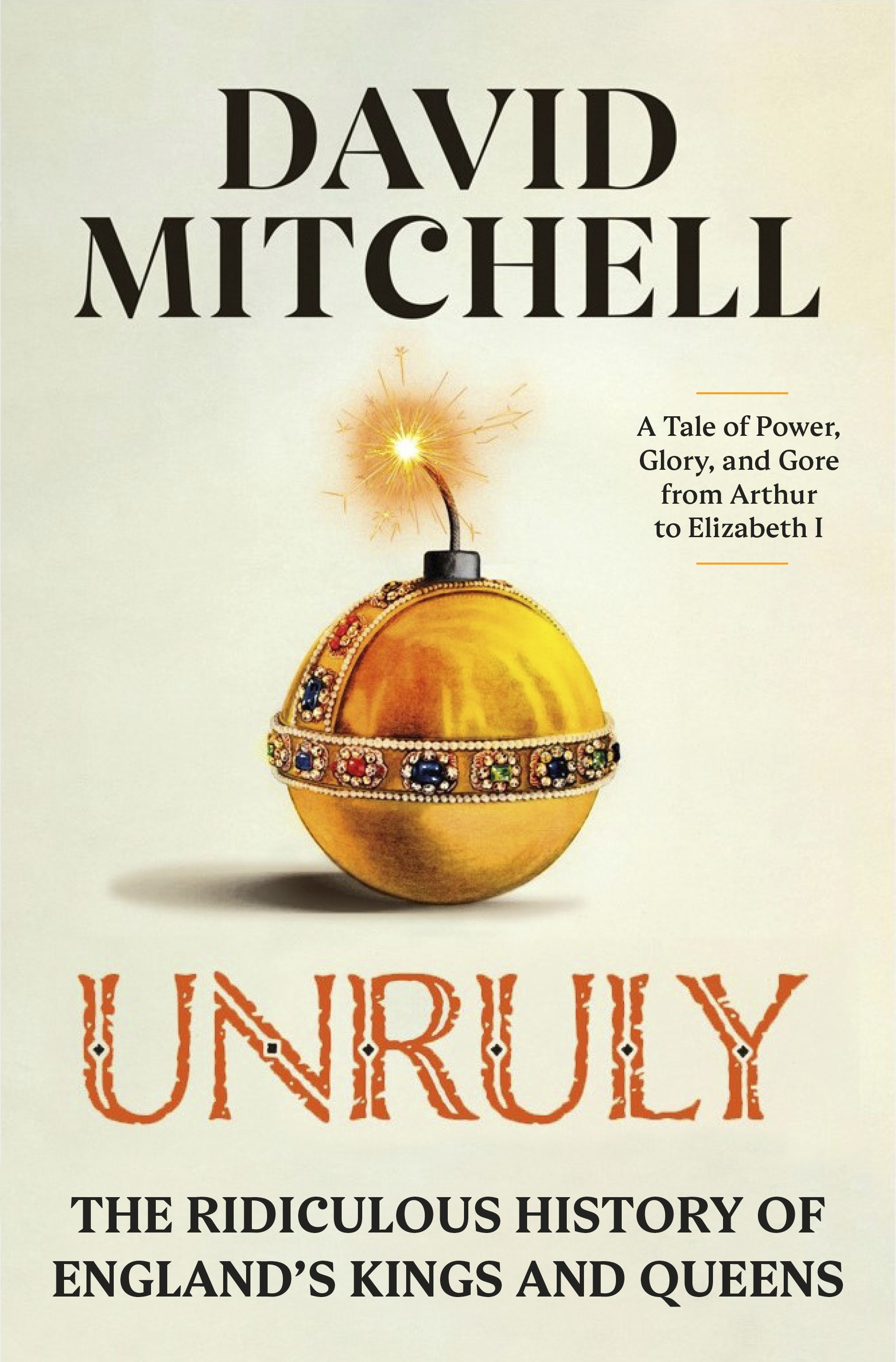
I’m always a sucker for history books, but this one especially caught my eye as I like the writer both as a comedian (who I listen to often on the radio and see occasionally on TV) and as a person (having read parts of his autobiography and from generally listening to the things he says). I think David Mitchell is very funny but he’s also a nice guy and smart without being smarmy about it.
So I got his book about the kings and queens of England. What could go wrong?
Well, honestly, nothing did. The book is hilarious but also informative. While it isn’t a huge tome, extensive in research and nor unwavering in uncovering every nuance in an unbiased way, Mitchell doesn’t pretend that it ever was going to do any of that in the first place. Indeed, he quite correctly mocks historians who do try to claim ‘absolute truth’ by stuffing their books with tons of evidence that fits their perspective. He’s quite right to point out that historians just love arguing with one another and saying why the other is an idiot. They do. I’ve been at social gatherings where I’ve seen them do it. It’s as weird as feck, I can tell you.
Instead, what you get from Mitchell is a very witty commentary and summary of the kings and queens starting with King Arthur (a short chapter because – spoiler – he never existed) and ending at Queen Elizabeth I where one could argue the monarchy ceased to be ruling with absolute power and where parliament and government really take control of things. In terms of looking at the ridiculousness of rulers ruling because of Pythonesque rituals and on the basis of who had the biggest dick army or sword, it pretty much ends with Lizzie, so fair enough.
Mitchell confesses to be an amateur historian but also an informed one, and writes his personal take on the comings and goings of these rulers and upstarts with this very much in mind. He brings to the surface just how bizarre it is to decide that someone should be king just because they say so, let alone that they can then pass that kind of power and privilege onto their offspring by some divine right. It’s madness, he says, and yet in many ways the alternative was worse. Indeed, he points out that the country was often at its shakiest when that ‘divine right’ was doubted in any way.
Nevertheless, you do come away feeling that Mitchell thinks the whole thing is nuts. Fascinating, as a historian, but bonkers. I’m absolutely with him on that one.
I’m unashamedly a republican. No, not a US Republican – I think the idea of Trump as president is every bit as loopy as a sword-wielding monarch – but in favour of the dissolution of the mechanisms of monarchy and the replacement with an elected Head of State. While Mitchell is writing a history book that ends over 400 years ago, his comments are illuminating and often shed rather horribly glaring lights on the state of play today.
What becomes wonderfully clear is that the British people don’t like change because they find it unsettling. In the past, Mitchell asserts, they’d rather have a bad king who has a solid basis for being king than a good kind whose standing is rocky. What matters on a day to day basis is peace – so you can get on with feeding your family without worry of having your village burned to the ground or your men forced to fight and die on some boggy field.
It is the same today. We’d rather have the useless and repugnant Charles on the throne because ‘tradition’ than replace him with god knows what and risk having a Trump or a Boris as president here. The fact that this is all absolute nonsense – there’s so many republics around the world that run successfully you need never look at the US model – is irrelevant. People don’t like change.
But change comes. And often it is through small steps that might be considered ‘through the back door’ – like Mitchell’s book. I think it should be required reading for any student about to take on A level History or the equivalent. They should read it over the summer beforehand. Not only is it fun to read and relatively short too, but it gives a good grounding for whatever periods of history they study (almost inevitably the Tudor period). And on top of that, they will come away seeing just how farcical the whole thing is.
My Verdict:

Social Entrepreneur, educationalist, bestselling author and journalist, D K Powell is the author of the bestselling collection of literary short stories “The Old Man on the Beach“. His first book, ‘Sonali’ is a photo-memoir journal of life in Bangladesh and has been highly praised by the Bangladeshi diaspora worldwide. Students learning the Bengali language have also valued the English/Bengali translations on every page. His third book is ‘Try not to Laugh’ and is a guide to memorising, revising and passing exams for students.
Both ‘The Old Man on the Beach’ and ‘Sonali’ are available on Amazon for kindle and paperback. Published by Shopno Sriti Media. The novel,’The Pukur’, was published by Histria Books in 2022.
D K Powell is available to speak at events (see his TEDx talk here) and can be contacted at dkpowell.contact@gmail.com. Alternatively, he is available for one-to-one mentoring and runs a course on the psychology of writing. Listen to his life story in interview with the BBC here.
Ken writes for a number of publications around the world. Past reviewer for Paste magazine, The Doughnut, E2D and United Airways and Lancashire Life magazine. Currently reviews for Northern Arts Review. His reviews have been read more than 7.9 million times.
Get a free trial and 20% off Shortform by clicking here. Shortform is a brilliant tool and comes with my highest recommendation.


 Write Out Loud (Reviews and Writing)
Leave a comment