
“…There’s the crux of what he did wrong. He put in huge amounts of effort to memorise very specific things…but didn’t find anything practically useful to him on a day-to-day basis…”
This is my second review where I have to give fair warning of a conflict of interest. My first was the review of Harry Lorayne’s classic book on memorising.
As I pointed out in that review, the conflict is that this book is on memorisation (or mnemonics, as it is known properly) and I have written a wonderfully successful book on exactly that subject. I will make comparisons and, yes, I am going to try and persuade you to buy my book (if you haven’t already) but I do hope to be as fair as possible. As with Lorayne’s, you’ll find a summary of Foer’s book on Shortform that you might want to check. There’s nothing to stop you buying and reading both my book and Foer’s, of course…
One of the best aspects of this book is that it is very much semi-biographical as it charts the author’s journey from memory novice to competition level memorising. Along the way, he reviews and interviews of the literature and people involved in the world of memory, from memory experts to scientists in the field.
A good chunk of the book looks at the neurology and theory of memorising. It’s mostly good stuff, though I take exception to the old tired writing about short term and long term memory. I concede I’m a lone voice in dismissing these concepts that come from psychological theory that’s well over fifty years old and horribly out of date, but I would have liked to see some fresh thinking.
Another large chunk looks at the history of memorising. It’s all good stuff again, including getting in some mention of my hero, Tony Buzan. I have just a little bit of a worry though that this is all leading up to a sucker punch for the reader. By informing you so much of the science and history of it all, the techniques about to be taught get given a veneer of authority and respectability.
As I could have predicted, the principle method taught is that of visualisation and association. The ‘Memory Palace’ principle is trotted out along with a strong of independent ideas for memorising. Even the so-called ‘Major System’ – that I refer to in my book as ‘The Consonant System’ – is presented.
Foer then presents something vaguely new(ish) – The Person-Action-Object System. It’s a nice idea but involves memorising a visual sentence (such as Einstein brushing his hair) for all numbers from 00 to 99 and then stringing the person, action and object from each of them to memorise longer numbers.
Super cool. Absolutely pointless.
Unless you intend to become a memory athlete, competing to memorising huge strings of numbers, it’s a complete waste of time. Indeed, I doubt many (if any) readers will get past the memorising the sentences stage before giving up. It’s also unnecessary for memorising large chunks of data. In my book I teach how to memorise long sets of data and give pi to 20 decimal places or more. I also teach a trick for completing ‘The Knight’s Tour’ – a magic trick where you start with the knight on any square on the chess board and move it to every single other square without repeats and without looking at the board. It requires you to memorise 64 double-digit numbers in strict and cyclic order. That sounds incredibly difficult to do, and yet I’ve had students learn to do this in less than ten minutes – once they know my system.
There’s nothing wrong with the techniques Foer teaches here. In fact, there’s really no other way to memorise than use visualisation – the weirder, the better, the very fact that gives my book its title. But, as with Lorayne’s book, there’s very little advice to make these techniques genuinely useful in real life.
The most disappointing part of this book is that Foer, having won the 2006 US Memory Championships, got hammered in the World Memory Championships and promptly gave up memorising, preferring instead to use ‘external memory aids’ such as a dictaphone. There’s the crux of what he did wrong. He put in huge amounts of effort to memorise very specific things (like the order of two shuffled decks of cards) but didn’t find anything practically useful to him on a day-to-day basis. His readers won’t find anything practically useful even though the right ideas are all there.
I’ve never had the urge to enter memory competitions, it’s a pointless task because – as Foer’s book effectively points out – it’s a big ‘easy’ magic trick. These aren’t incredible brains with exceptional talents. They’re just guys who’ve learnt tricks and practised them a lot. I really don’t want to hang out with such bizarre people – despite being pretty bizarre myself!
I’ve certainly performed the tricks though. I love doing Knight’s tour and can memorise cards relatively easily; but more importantly, I’ve used my method again and again in real life. and with my students, I’ve taught them to use it to pass exams. It’s also turned out to be much easier and a hell of a lot more fun to use my method for exams than the traditional ‘rote learning’ method of ‘read and write it, over and over again’.
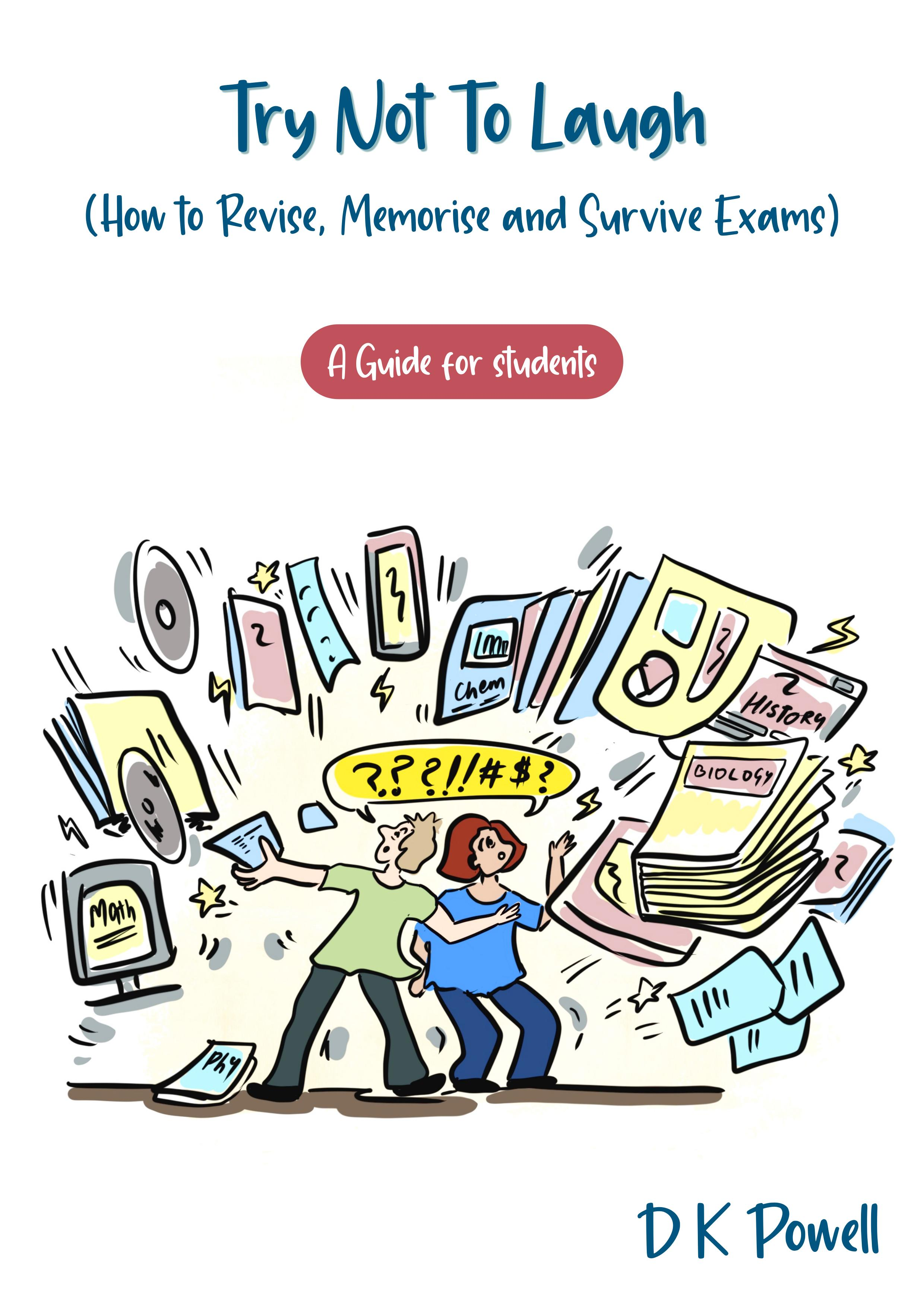
My book, Try Not To Laugh, was written deliberately to help students have a systematic set of principles they can use for a range of academic topics. It is a practical guide to how to actually memorise the hard stuff – like numbers and esoteric things like the colours various chemicals go in the infamous ‘tests’ that so many school curriculums demand their students know. It includes dietary information, how to revise alone in various settings and how to revise together. It tells you the pitfalls to watch out for and gives multiple examples of memorising numbers, science information, faces and names, languages and so on.
The methods I’ve put together into the comprehensive system detailed in the book come from decades of using this with actual students to pass actual exams. The last few years since Covid has seen this more necessary than ever before.
For the last few years (post-Covid) I’ve seen so many covid kids who have done their first year of A level Biology (for instance) struggling with the sheer amount of things they’re supposed to know. They come to me with less than a year to go before exams and very much behind. I’ve lost track how many times, after learning the relevant parts of my system, they leap forward with confidence within a couple of months and catch up with the course, better equipped to recall information with relative ease. I’m not pretending this suddenly makes revising easy – and my book explains at the neurological level exactly why it will never be so – but a good mnemonic technique like mine will make the job a lot lot easier and faster. That’s essential when you’re behind.
The traditional answer to learning something has always been: write it out over and over again until it sticks. But this is a dreadful method that alienates many of us on the neurodiverse spectrum who simply can’t do it. It’s also a terribly time-consuming method that wastes precious revision time. Joshua Foer’s method – fundamentally the same as all memory artists around the world – is exactly the right principles, but just fails to show you how to put it into action. It’s for that reason the author himself walked away from it all. I would like to think my book gets it right. I’m proud of the fact that my students and I all use mnemonic techniques for practical, real world purposes.
In the end, no one is walking away from Foer’s book with a better memory than they started with. For that, buy Try Not To Laugh.
My Verdict:

Interested in learning more about this book? Shortform provide a brilliant set of summary notes you will find really helpful. Get your free trial here with 20% off the subscription you use the link.

Social Entrepreneur, educationalist, bestselling author and journalist, D K Powell is the author of the bestselling collection of literary short stories “The Old Man on the Beach“. His first book, ‘Sonali’ is a photo-memoir journal of life in Bangladesh and has been highly praised by the Bangladeshi diaspora worldwide. Students learning the Bengali language have also valued the English/Bengali translations on every page. His third book is ‘Try not to Laugh’ and is a guide to memorising, revising and passing exams for students.
Both ‘The Old Man on the Beach’ and ‘Sonali’ are available on Amazon for kindle and paperback. Published by Shopno Sriti Media. The novel,’The Pukur’, was published by Histria Books in 2022.
D K Powell is available to speak at events (see his TEDx talk here) and can be contacted at dkpowell.contact@gmail.com. Alternatively, he is available for one-to-one mentoring and runs a course on the psychology of writing. Listen to his life story in interview with the BBC here.
Ken writes for a number of publications around the world. Past reviewer for Paste magazine, The Doughnut, E2D and United Airways and Lancashire Life magazine. Currently reviews for Northern Arts Review. His reviews have been read more than 7.9 million times.
Get a free trial and 20% off Shortform by clicking here. Shortform is a brilliant tool and comes with my highest recommendation.


 Write Out Loud (Reviews and Writing)
Leave a comment