“…illuminating and helpful for understanding India’s place in the world…”
I have to confess a slight bias regarding the author as I have followed him on Twitter for a long while and found I very much like the man and what he stands for, especially in his love and concern for Palestinians during the current conflict with Israel. He seems a gentle soul with a passion for justice and understanding others.
So when I found he’d published this book, I knew it was time to finally read something of this much-published-and-praised author. It had to be about India, of course, that’s what Dalrymple is known for. Despite being white and very distinctly British (with a very entitled upbringing), he seems to have avoided most of the criticisms levelled at British writers when writing about India. Rather than be dismissed as yet another post-colonial Englishman mansplaining to the rest of the world, he is accepted as an expert in matters regarding India and surrounding lands pretty much around the world. I can think of no other white writer who enjoys such acclaim both in India and out.
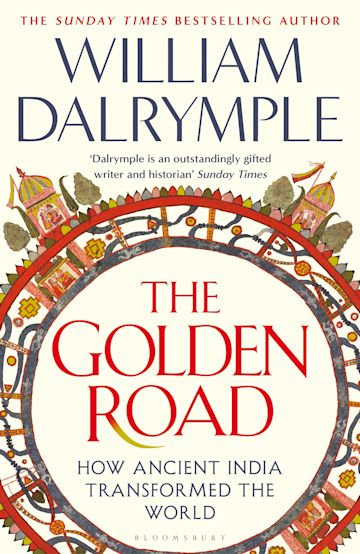
On reading The Golden Road it becomes obvious why this is so. Dalrymple writes with a love and respect for India that is contagious. He writes of ancient history almost as if he’s writing beloved fairy tales – perhaps a tale of Arabian Nights or Kipling-esque Jungle Book. He moves from his telling of history to the quoting of historical figures telling their own story so seamlessly that the effect is magical and breathtaking. At times, you feel you’re reading a novel, not a dry, academic tome.
Of course, there is a theme and that means, to an extent, there is a bias in his version of history. India is placed at the centre of the ancient world, displacing China, Arabian lands and certainly Europe. The Silk Road routes, specifically where they engaged China, were not the major players in this version. All roads led to India until the very successes of India led to its own downfall by the time the English came to take over.
Dalrymple makes convincing arguments and while his research is up to date, he is careful not to overplay newer, more controversial theories, making it clear where hypotheses are contested. Most of his research is rooted deeply in solid, well-established information, easily verifiable.
His success is in making the links that were always there but are easily missed by the casual historian. It’s too easy for the layperson to trot out the simplistic ideas received from school days such as the West found its renaissance thinking by rediscovering the Greeks and Romans, that our numbers came from Arabic, and that we brought knowledge and learning to India and beyond. Nothing is further from the truth. Even if you know more, such as much of our renaissance knowledge coming from, and being inspired by, Arabic books, this author shows us that even this is not the whole truth.
Instead, Dalrymple argues persuasively for India being the smelting pot of Greece, Rome, China, Middle East and huge swathes of Asia, who all either came to India for trade or learning, or hosted Indian merchants, royalty or philosophers themselves. The result is we find the Indian touch everywhere, influencing and even leading the way, again and again. Early on, the cultural impact of Buddhism is explored, but later on it is something as profound as the concept of zero – without which, maths and science could not have flourished – that we see ping-ponging between nations and cultures.
So, while the lens is very precise – putting India at the centre – the author’s breadth and depth of history expertise is such that his argument is compulsive. In this respect, this book is an excellent companion to Peter Frankopan’s Silk Road history placing, as it does, Asia at the centre of history and culture rather than Britain and Europe. You don’t need to be convinced of all arguments to find The Golden Road illuminating and helpful for understanding India’s place in the world. At the very least, allow yourself to join Dalrymple in the joy of exploring this immensely beautiful land and its brilliant people.
My Verdict:

Interested in learning more about this book? Shortform provide a brilliant set of summary notes you will find really helpful. Get your free trial here with 20% off the subscription you use the link.

Social Entrepreneur, educationalist, bestselling author and journalist, D K Powell is the author of the bestselling collection of literary short stories “The Old Man on the Beach“. His first book, ‘Sonali’ is a photo-memoir journal of life in Bangladesh and has been highly praised by the Bangladeshi diaspora worldwide. Students learning the Bengali language have also valued the English/Bengali translations on every page. His third book is ‘Try not to Laugh’ and is a guide to memorising, revising and passing exams for students.
Both ‘The Old Man on the Beach’ and ‘Sonali’ are available on Amazon for kindle and paperback. Published by Shopno Sriti Media. The novel,’The Pukur’, was published by Histria Books in 2022.
D K Powell is available to speak at events (see his TEDx talk here) and can be contacted at dkpowell.contact@gmail.com. Alternatively, he is available for one-to-one mentoring and runs a course on the psychology of writing. Listen to his life story in interview with the BBC here.
Ken writes for a number of publications around the world. Past reviewer for Paste magazine, The Doughnut, E2D and United Airways and Lancashire Life magazine. Currently reviews for Northern Arts Review. His reviews have been read more than 7.9 million times.
Get a free trial and 20% off Shortform by clicking here. Shortform is a brilliant tool and comes with my highest recommendation.


 Write Out Loud (Reviews and Writing)
Leave a comment