or Making Sure You Keep Your Reader’s Attention

“…if you craft your characters with care and attention…you might just have your own iconic turtle moment too...”
Although it took me several decades to realise it, I think John Steinbeck’s The Grapes of Wrath is a brilliantly written novel. I’m not alone, obviously, with the book unfailingly appearing on the top 100 books to read lists wherever you look. There’s no chance of this book falling out of favour any time soon.
And yet, weirdly, Steinbeck pulls a strange one with his third chapter of the novel. We’re just getting started with the epic journey across America that the Joad family must endure as a result of the Great Depression and the desperate need to find work. We’ve barely invested ourselves in these characters in just two chapters.
What does Steinbeck do in chapter 3? Devotes the entire chapter to telling us about a turtle trying to cross the road. Madness! It’s off the wall and so completely irrelevant to the story. Editors and agents looking at this as a manuscript from an unknown newbie writer would be like ditch the turtle.
This is why I always advocate that ‘rules’ should be seen as nothing more than guidelines. I try to push that message home to all my students and clients. When you’re new at the game, absolutely follow the advice; and when writing for a certain kind of publication or editor, follow their house rules. But once you’ve gained experience and understand what the ‘rules’ are trying to tell you, feel free to ditch as you see fit. Just make sure you know exactly why you’re doing so.
Steinbeck knew what he was doing.
Out of the entire, epic, brilliant novel, it is that damned turtle I think about more than anything, or anyone, else. Now while that might be an oddity about me (we’ll come back to that), I know from both talking to many others who’ve read the book and from the many analytical essays on the book online that I’m not the only one who really got hooked by the turtle.
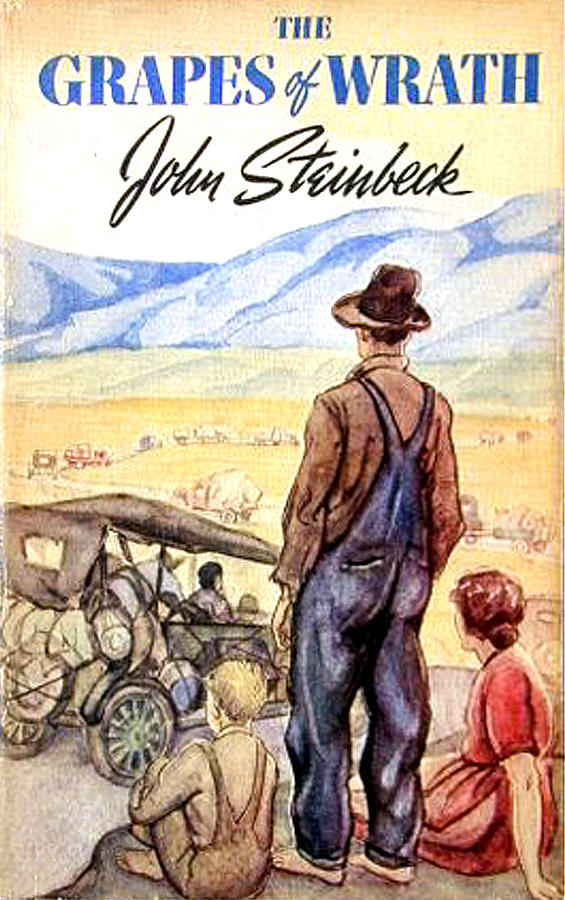
If you’ve not read the book, I won’t go into too much detail. You should just read it for yourself (you really should). But briefly, in this chapter we are told of the turtle’s attempt to cross a road. A car swerves to avoid it but then a truck deliberately hits it, sending the poor creature onto its back. It manages to right itself eventually, but then is attacked by an ant which it crushes. When the turtle finally makes it to the other side, some seeds are released from its shell that it picked up along the way and its shufflings in the dirt bury the seeds. The main character in the story then ends up picking up the turtle and keeping it as a family pet.
As far as I can recall, the turtle doesn’t feature in the story again. Its job is done. Most commentators recognise the chapter as being a superb analogy or metaphor for the immense struggle of the Joad family, themselves crossing to ‘the other side’. Some people hurt them, some people help. Along the way, work is done, regardless of intent, in just the same way the turtle accidentally sows seeds into the ground so they can grow.
I think for most people, that’s the end of the story for the turtle – a brilliant visual representation or perhaps foretelling of what will happen to the Joad family throughout the remaining twenty-seven chapters. Job done, even if it was a bit of a weird thing to shove in just two chapters in.
But for me, I want to know what happened next to the turtle!
It’s daft, I know, but I felt more empathy for the poor, brave creature than I did for most of the characters in the book. It’s not like I didn’t like the characters – I did! – but the turtle hit me harder.
Now that might make me a little strange (it wouldn’t be the first time someone has suggested it) but, as I tell my writer clients when editing their work, if I pick up on something – good or bad – then there’s a good chance that other readers will to. And editor is, or should be, a reader first. Grammar, spelling, structure, blah, blah, is a technician’s work. It’s important, but irrelevant if the flow of the story doesn’t work for the reader. The main point here is that I was hooked over Steinbeck’s turtle and that means others will have been hooked too – even if we’re a minority.
And that’s the essence of good writing. Steinbeck was so good at it, he could write a chapter – whose main function was to step back from the story and give the reader a chance to ponder the depths of what is going with the characters – and give it that certain something that makes it unforgettable, possibly even iconic. The turtle really isn’t a character in this book, he’s just a bit part. Yet, he’s remembered better than many of the characters who are important.
When writing fiction, you should consider strongly the element of ‘hooking the reader in’. Of course, your main characters and plot need it. But if you give the same care to other parts, you have a story that draws you in.
Conversely, if you have characters that don’t have that draw, consider whether or not you really need them in at all. In a short story this is essential. Many a newbie writer has made the mistake of giving too much page space to a character that has no relevance other than to briefly drive on a scene or plot. A classic mistake is to give a name to such characters. When you have a name, you’ve got involved with someone. It’s annoying and can be confusing for readers when they’re given names – indicating importance – only to never see that character again.
Steinbeck knew his turtle was important, even if it was just for prolepsis and analogy. So he gave it a struggle and had us rooting for the creature. We almost sigh with relief when he makes it to the other side in the end. It could have been just a paragraph long. Had it been a short story I doubt it would have been more than a couple of sentences – if it had made it in at all. But in a large novel, Steinbeck knew he could take his time and make us feel real empathy of the turtle. And if we can feel that. how much more can we feel for the plights of the characters as we, quite literally, take their journey across America with them? Indeed, we want to take that journey.
The oddity with me, I know, is that I want to know what happened next to the creature. If someone wrote a book from the perspective of the animal, I’d almost certainly buy it. That may be an oddity unique to me, but the principle of readers getting attached to side characters is not. It’s the reason for ‘world building’, as it is known, in series such as Middle Earth, Hogwarts or the Discworld. And Star Wars has built a huge franchise around an absolute plethora of characters often only seen on the screen for a fraction of a second. There’s so many ‘spin-offs’ from various books, it shows that humans just love to know about characters they’ve met than intrigued them.
Your next side character might be the start of a separate book one day. It probably won’t. But if you craft your characters with care and attention, no matter how small, you might just have your own iconic turtle moment too. At the very least, you’ll have a story that engages the reader much more successfully.
As a final note, I’m clearly not the only obsessing over this turtle. Someone took the ridiculous time and effort to do a LEGO animation of an interpretation, shall we say, of the chapter. Now that’s weird.
Read all A Brief Guide to Writing here:
A Brief Guide to Writing: 1 – Introduction
A Brief Guide to Writing: 2 – Why you shouldn’t be a writer
A Brief Guide to Writing: 3 – Thinking like a writer
A Brief Guide to Writing: 4 – Budgeting income as a writer
A Brief Guide to Writing: 5 – Mistakes, editing and you
A Brief Guide to Writing: 6 – The Writer and The Black Dog of Doom
A Brief Guide to Writing: 7 – Feedback
A Brief Guide to Writing: 8 – What Happened to That Damned Turtle?
A Brief Guide to Writing: 9 – Instant Plots

Social Entrepreneur, educationalist, bestselling author and journalist, D K Powell is the author of the bestselling collection of literary short stories “The Old Man on the Beach“. His first book, ‘Sonali’ is a photo-memoir journal of life in Bangladesh and has been highly praised by the Bangladeshi diaspora worldwide. Students learning the Bengali language have also valued the English/Bengali translations on every page. His third book is ‘Try not to Laugh’ and is a guide to memorising, revising and passing exams for students.
Both ‘The Old Man on the Beach’ and ‘Sonali’ are available on Amazon for kindle and paperback. Published by Shopno Sriti Media. The novel,’The Pukur’, was published by Histria Books in 2022.
D K Powell is available to speak at events (see his TEDx talk here) and can be contacted at dkpowell.contact@gmail.com. Alternatively, he is available for one-to-one mentoring and runs a course on the psychology of writing. Listen to his life story in interview with the BBC here.
Ken writes for a number of publications around the world. Past reviewer for Paste magazine, The Doughnut, E2D and United Airways and Lancashire Life magazine. Currently reviews for Northern Arts Review. His reviews have been read more than 7.9 million times.
Get a free trial and 20% off Shortform by clicking here. Shortform is a brilliant tool and comes with my highest recommendation.


 Write Out Loud (Reviews and Writing)
Leave a comment