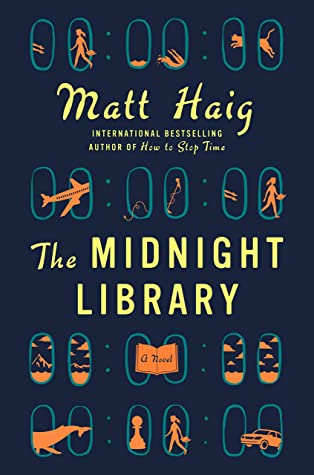
“…the story was a friend along the way, quietly holding my hand for a while…”
It’s been a while since I read a book by Matt Haig. The last one I reviewed was The Humans and I ended up giving quite a favourable review.
This very much surprised me because I think my attitudes towards the author have changed since writing about that novel. I’ve become more critical of his social media posting, feeling he just drones on about his depression, how far he’s come since the days of being suicidal and how much he struggles today. Get a grip, I often feel now.
But a lot of me is very much suspecting this is saying much more about me than it is about Matt Haig. My father’s inability to show deep emotion or admit weakness has grown into me as I get older. I look in the mirror these days and see my father staring back. Don’t get me wrong – he was a good man with many wonderful traits that I am proud to have inherited in part – but he was very much Victorian values, stiff upper lip kind of a man. I didn’t used to be like that but an awful lot of trauma has happened in the last eleven years and now I’m much more reserved.
Which is a very long, roundabout kind of way of saying that I wanted to hate The Midnight Library because of my issues, not Haig’s.
It felt like a really trite story. A woman, Nora Seed, has made a complete mess of her life – she can’t even keep her cat alive, she’s that bad – and has decided to end it all. In doing so, she ends up in ‘the Midnight Library’ containing all the books of all her potential lives. She can try them all out until she finds a life she does want to live. I could see what’s coming and, to be fair, I was largely right. But at the beginning I thought this was going to be full of gratuitous feel-good platitudes that would be cringe-worthy.
Of course, I was wrong.
I may be begrudging, but Matt Haig actually is a really good writer. His characters are authentic; they’re real. Everything is very believable – very British, indeed. I can see exactly why this book has been so successful and loved by a lot of people. The book resonates.
It hits my most important marker for fiction: do I care what happens next to the character(s) after the book is closed for the last time? The answer is: yes, absolutely. I want a sequel to see Nora’s life after this book. That won’t happen, of course, but I want it and I’ve enjoyed imagining her life now since finishing the book. That’s as high an accolade as I can give really, such as it is.
While the end is inevitable, the journeys Nora takes are fascinating as she imagines every conceivable version of who she might have become. As she does this, her regrets about her ‘root’ life disappear. It turns out she isn’t the one responsible for the woes of others and some ‘good decisions’ actually would have had terrible ramifications. For a while, this looks like it makes things even worse for Nora – there’s no such thing as a perfect life – but Haig is able to turn this around in a way that naturally transitions so you don’t notice it coming.
The book is very readable. While the opening chapters are a bit bleak, Haig writes with charm and humour throughout. Nora’s ‘black dog’ lifts over time and the book quickly becomes quite uplifting without having to try hard or spell it out in heavy-handed clichés.
Given my above bias against the author and this book, I feel it was quite a good one for me to read at this point in my life where things are ‘a little difficult’, as the British might say. It’s not going to change my life, nor make me see things differently, but I do feel the story was a friend along the way, quietly holding my hand for a while. I will miss Nora, but I’m grateful to Matt Haig for introducing her to me. I recommend you meet her too.
My Verdict:

Social Entrepreneur, educationalist, bestselling author and journalist, D K Powell is the author of the bestselling collection of literary short stories “The Old Man on the Beach“. His first book, ‘Sonali’ is a photo-memoir journal of life in Bangladesh and has been highly praised by the Bangladeshi diaspora worldwide. Students learning the Bengali language have also valued the English/Bengali translations on every page. His third book is ‘Try not to Laugh’ and is a guide to memorising, revising and passing exams for students.
Both ‘The Old Man on the Beach’ and ‘Sonali’ are available on Amazon for kindle and paperback. Published by Shopno Sriti Media. The novel,’The Pukur’, was published by Histria Books in 2022.
D K Powell is available to speak at events (see his TEDx talk here) and can be contacted at dkpowell.contact@gmail.com. Alternatively, he is available for one-to-one mentoring and runs a course on the psychology of writing. Listen to his life story in interview with the BBC here.
Ken writes for a number of publications around the world. Past reviewer for Paste magazine, The Doughnut, E2D and United Airways and Lancashire Life magazine. Currently reviews for Northern Arts Review. His reviews have been read more than 7.9 million times.
Get a free trial and 20% off Shortform by clicking here. Shortform is a brilliant tool and comes with my highest recommendation.


 Write Out Loud (Reviews and Writing)
Leave a comment