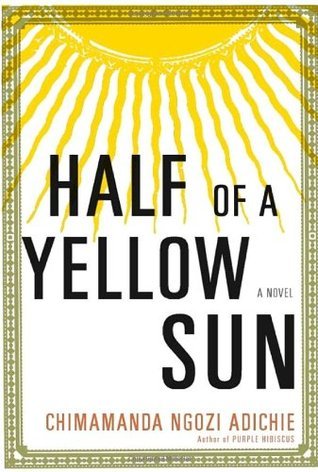
I have become accustomed to disappointment when picking up a relatively new book (as in, written with the last 15 years) which everyone tells me is ‘a classic’. I can think of several such books I’ve read where, at best, they are good – but certainly not worthy of the titles of ‘classic’ or ‘masterpiece’.
I had misgivings about reading Chimamanda Ngozi Adichie’s novel which is essentially an excuse to tell, in pseudo ‘eye witness’ form the story of the revolution in Nigeria during the 1960s. I recall reading ‘Cutting for Stone’ by Abraham Verghese and how unmoved I was about Ethiopia in doing so. I expected to be deeply touched and to learn a great deal about an African nation of which I know very little. The book was well written, of that there is no doubt, but I failed to engage with the characters nor with the culture and that saddened me.
As I began ‘Half of a Yellow Sun’ I was troubled by similar thoughts. I did not feel empathy for Olanna or her cold-hearted twin sister. I didn’t like Odenigbo and his snobbish intellectualism. Richard, the sole British white main character, was ineffectual and disappointingly stereotypical of the ‘Englishman abroad’. Only Ugwu, the servant boy employed by Odenigbo, stirred any sympathies within me at all. And I cared nothing for the Nigeria portrayed.
But by the time I was a third of the way through the novel something had gripped me. I don’t know whether it was intrigue or a warming to the characters – I honestly can’t put my finger on what it was – but I felt compelled to continue. By the halfway point I was hooked in every way.
From there on the intensity only increased and it did not let up even right to the very end. The sign of a good novel, for me, is that I care about the characters at the end and want to know what happens next to them. This was certainly true for this book (almost horrifically so in some cases). The author skilfully avoids making everything a dreadful nightmare for the characters nor glosses over with a ‘happily ever after’ cliché. There are victories and failures; gains and losses; joy and sorrow – all of which give this book a deep sense of truth and reality. We see both the beauty and the ugliness of the characters but not so much of either that they lose their value.
Moreover, I cared not just for the characters but for the people as a whole. A nation pulled apart by civil war, I can sympathise with the effect this must have had on Nigerians. The author tells the story exclusively from the side of the people who lost (this is no spoiler, there is no state of ‘Biafra’ as such today) and so cleverly lets us sit with these people as they suffer and grieve.
To call ‘Half of a Yellow Sun’ beautiful would be a misnomer. There is very little beauty in what the author forces us to visualise. But it is hard to imagine a better crafted novel, a more moving tale, a more disquieting and unsettling inspection of humanity in all its weaknesses and sins, yet not draining us of hope.
Apart from one part where we jump forward in time and we’re left for a while to wonder what happened before then telling us the missing part (for a reason I cannot fathom as the device is not used again and simply isn’t justified at all) this novel is perfect in form, language and plot. It truly is a classic and worthy to remain as a must-read for decades to come.
My verdict:

Social Entrepreneur, educationalist, bestselling author and journalist, D K Powell is the author of the bestselling collection of literary short stories “The Old Man on the Beach“. His first book, ‘Sonali’ is a photo-memoir journal of life in Bangladesh and has been highly praised by the Bangladeshi diaspora worldwide. Students learning the Bengali language have also valued the English/Bengali translations on every page. His third book is ‘Try not to Laugh’ and is a guide to memorising, revising and passing exams for students.
Both ‘The Old Man on the Beach’ and ‘Sonali’ are available on Amazon for kindle and paperback. Published by Shopno Sriti Media. The novel,’The Pukur’, was published by Histria Books in 2022.
D K Powell is available to speak at events (see his TEDx talk here) and can be contacted at dkpowell.contact@gmail.com. Alternatively, he is available for one-to-one mentoring and runs a course on the psychology of writing. Listen to his life story in interview with the BBC here.
Ken writes for a number of publications around the world. Past reviewer for Paste magazine, The Doughnut, E2D and United Airways and Lancashire Life magazine. Currently reviews for Northern Arts Review. His reviews have been read more than 7.9 million times.
Get a free trial and 20% off Shortform by clicking here. Shortform is a brilliant tool and comes with my highest recommendation.


 Write Out Loud (Reviews and Writing)
Leave a comment