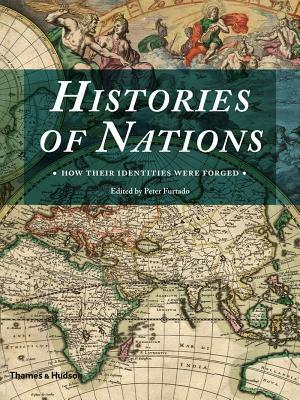
I’ll come straight to it: this book is utterly pointless.
It’s a pity because it need not have been. The idea – of presenting a brief history of twenty-eight of the major nations of the world – was a good one.
There is, of course, an immediate issue with deciding which twenty-eight should be chosen out of the nearly two hundred countries broadly recognised today. What is a ‘major nation’? This is a fair point, but if you’re going to choose a small selection (for a book not to become an intimidating tome) then the selection is about as good as you’re going to get and does at least make sure that all inhabited continents are covered. With the aim of getting people to know stuff about other histories than their own, it had the right idea. This could have been a useful summary for those wanting a broad introduction rather than depth.
But in choosing ‘select experts’ to write each article, what becomes quickly apparent to those of us who have some deeper knowledge of the history of some of these nations is that each article is, at best, deeply biased. As a British person, I couldn’t disagree with Jeremy Black’s assessment of our history more, for instance, but there were several other essays where I found myself wincing or grimacing.
This shouldn’t have come as a surprise. As a teacher of history, I know that there is a great (and correct) preoccupation in education practice today to teach students how to critically assess not just the content of an historical source document but its reliability and credibility. History, as they say, is written by the victors. Today it might be better to say it is written by those who argue best their own particular bias. It is certainly amusing (I have done this) to be sat with several historians at the same time and watch them quickly find huge swathes of history to argue over and ridicule one another’s stances.
There is no ‘one history’ for any country but alas the uninitiated here would easily think there is. The compilers of this collection should have commissioned at least two, if not three, historians for each article to give at least a semblance of balance. It still wouldn’t be perfect but at least there would be some kind of nuance; a sense of grey areas of interpretation.
As it stands, I would have better invested the time spent reading this book in reading Wikipedia instead. Don’t get me wrong – that’s no slur to either – but researchers know that Wikipedia is a good place to start, getting a feel for a subject, and then find the references to use as springboards into decent primary sources. You never quote Wikipedia as a source in academia, but almost everyone knows it is your usual starting point. This book doesn’t even provide references. It’s just one person’s opinion, repeated ad nauseam.
There is some good material in here. I certainly felt like I learned something with some of the articles. But the problem is I can’t ever really be sure. Did I learn something? Or did I just read something conjured out of someone’s head, concocted from opinion? I can’t ever know without having to go check it out myself. In which case, I might just as well have gone to better sources anyway.
This should have been a useful resource for students of history. I always recommend my students try to get a breadth of world history. I often suggest Frankopan’s excellent The Silk Roads for this reason which, while it is one man’s work, has copious citations you can use to check out details for yourself. Getting a view of a country in the context of at least its neighbouring nations (though it is better to get a more global perspective if possible) is a healthy thing to do. In the UK, this isn’t done enough and thus our colonial elitism has never been excised; instead, it has grown and become belligerent. So, this book misses a trick here and does somewhat nullify its own purpose. What a great pity. It could have been so good.

Social Entrepreneur, educationalist, bestselling author and journalist, D K Powell is the author of the bestselling collection of literary short stories “The Old Man on the Beach“. His first book, ‘Sonali’ is a photo-memoir journal of life in Bangladesh and has been highly praised by the Bangladeshi diaspora worldwide. Students learning the Bengali language have also valued the English/Bengali translations on every page. His third book is ‘Try not to Laugh’ and is a guide to memorising, revising and passing exams for students.
Both ‘The Old Man on the Beach’ and ‘Sonali’ are available on Amazon for kindle and paperback. Published by Shopno Sriti Media. The novel,’The Pukur’, was published by Histria Books in 2022.
D K Powell is available to speak at events (see his TEDx talk here) and can be contacted at dkpowell.contact@gmail.com. Alternatively, he is available for one-to-one mentoring and runs a course on the psychology of writing. Listen to his life story in interview with the BBC here.
Ken writes for a number of publications around the world. Past reviewer for Paste magazine, The Doughnut, E2D and United Airways and Lancashire Life magazine. Currently reviews for Northern Arts Review. His reviews have been read more than 7.9 million times.
Get a free trial and 20% off Shortform by clicking here. Shortform is a brilliant tool and comes with my highest recommendation.

Social Entrepreneur, educationalist, bestselling author and journalist, D K Powell is the author of the bestselling collection of literary short stories “The Old Man on the Beach“. His first book, ‘Sonali’ is a photo-memoir journal of life in Bangladesh and has been highly praised by the Bangladeshi diaspora worldwide. Students learning the Bengali language have also valued the English/Bengali translations on every page. His third book is ‘Try not to Laugh’ and is a guide to memorising, revising and passing exams for students.
Both ‘The Old Man on the Beach’ and ‘Sonali’ are available on Amazon for kindle and paperback. Published by Shopno Sriti Media. The novel,’The Pukur’, was published by Histria Books in 2022.
D K Powell is available to speak at events (see his TEDx talk here) and can be contacted at dkpowell.contact@gmail.com. Alternatively, he is available for one-to-one mentoring and runs a course on the psychology of writing. Listen to his life story in interview with the BBC here.
Ken writes for a number of publications around the world. Past reviewer for Paste magazine, The Doughnut, E2D and United Airways and Lancashire Life magazine. Currently reviews for Northern Arts Review. His reviews have been read more than 7.9 million times.
Get a free trial and 20% off Shortform by clicking here. Shortform is a brilliant tool and comes with my highest recommendation.


 Write Out Loud (Reviews and Writing)
Leave a reply to Ken Powell Cancel reply