“…a terrific book to get the brain juices going…(but) doesn’t put its money where its mouth is…”
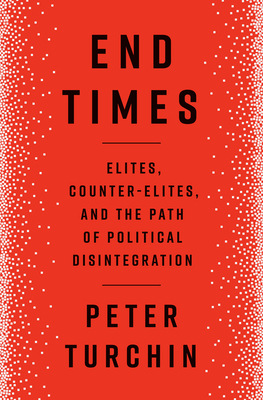
This was a fascinating book suggested to me by my fellow podcaster, Nicholas Graham, and one we may well talk about in our next podcast. End Times is far from a perfect work, but it is a wonderful resource full of interesting theories that beg to be talked about.
Turchin lays out his theory, ostensibly predictive, of ‘cliodynamics’ that deals with the dynamics of ‘end times’ of political states and institutions.
The main premise of Turchin’s book is that what he calls ‘elite over-production’ results in dynasty downfall. In other words, if you have too many elites vying for too few top positions, dissatisfaction brews and this will, sooner or later, lead to revolution. For this reason, Turchin says, polygamous ruling states always fall faster than monogamous ones simply because more elite are produced faster. No wonder polygamous states have all but fallen by the wayside. They effectively eat themselves alive.
There is another aspect however: that of ‘immiseration’ – a word I must confess I’d never encountered before reading this book but now find popping up in all sorts of texts. Technically, this means economic impoverishment, but I like to think of it more literally and see it as everyone getting pretty miserable. Effectively, they are same thing in this case. Revolution will occur when the lowest classes are impoverished enough that they overthrow the ruling classes. This usually occurs as a consequence of the afore-mentioned over-production of elites.
It’s not all as straightforward as that however. Perhaps the best parts of Turchin’s book are his discussions of world history that are often eye-opening when seen through the lens of cliodynamics. He argues that many revolutions simply see the return of cultural mechanisms that were the same as before – both Egypt’s Arab Springs revolts (that merely resulted in a return to the same style of government they’d had for a long time) and China’s communist revolution (likewise can be seen as nothing more than the successor to the Ching dynasty, the C of Communist might as well be C for Confucianist, he argues), are examples of this. Cultures inevitably return to their norms, he argues.
Turchin goes further. Abraham Lincoln is not the hero of emancipation. That’s a big statement to make. Turchin argues he took advantage of a political situation at the time to make a moral stand he arguably didn’t believe in. America’s southern states controlled power through slavery; the North did not. The North wanted to remove the power control of the South and so took up emancipation of the Negro slave as the cause.
Whether you agree with this – any of this – or not, there’s little denying the ideas are fascinating and worthy of much discussion. That’s what makes End Times so good. It makes you think.
The author looks at several societies and histories to make his points, some more modern and closer to home. Looking at European history, he argues most countries started off militaristically until becoming plutocracies with plenty of money from trading. Britain however, because of its unique geographic position as an island, ploughed that money into the navy and empire expansion. America was founded off the back of this and ‘inherited’ its plutocracy. Thus, America didn’t go through the stages most countries have to. This gives something of an explanation for the plutocracy that is the US today.
Interestingly, he points to two times in Europe’s history where revolution was avoided. England is the obvious one but the other less so – Russia. He is, of course, referring to 19th century Russia, a situation that wasn’t to last. In both cases though, it was the elites themselves who were able to rein in the excess and appease the masses enough to avoid the tipping point of popular immiseration.
Likewise, Turchin’s analysis of Ukraine is fascinating. He gives a balanced view, not often seen in the press – that of the western side the country favouring joining NATO, but the east side favouring Russia, both leaning closer to the sides they’re physically closer to. But just like Russia, Ukraine was hugely run by oligarchs favouring different sides. Multiple elections and the ultimate collapse of the system came because of plutocracy causing over-production of elites, in-fighting and, ultimately that led to the curveball that is Zelensky. The question Turchin asks is if the Ukraine will return to a militocracy – military leadership – when the current war is over. That’s if there’s a Ukraine left to govern, of course.
I’ve talked a lot more detail of the book than I would normal but that’s because it is all so very interesting. However, there are issues.
As Turchin talked of his Cliodynamics that can predict when ruling orders will collapse into revolution, I couldn’t help but think ‘my goodness he’s taken Asimov’s Foundation series seriously‘. Sure enough, in the appendices, Turchin discusses Asimov’s influence and the issues with the idea of a ‘psycho-history’ that can make predictions stretching thousands of years. That’s not possible in real life, he says. In the sci-fi series a character called The Mule turns out to be a spanner in the works. We are all, in a sense, ‘mules’, Turchin states.
Which is where cliodynamics fails. Having talked about the key factors necessary to predict how states will play out, the author then actively walks away from doing so, even though the book is written in the aftermath of Trump’s first term of office and in the midst of how Trumpism was playing out in America at the time of publishing. Interestingly, he makes a big thing of J.D. Vance – someone I’d never heard of before the election run-up – but seems to largely dismiss Trump himself – clearly, in retrospect, a mistake.
So this means the book is somewhat a theory in search of an end. We never get those Asimovian ‘rules’ for Cliodynamics, to use to save us from ourselves. Instead we get these tantalising ideas for the prime movers in political history, but ones that seemingly we can only use in hindsight to look at history and say, “See? That was over-production of the elites, that was!”
This is a terrific book to get the brain juices going or to take as conversation starters among your political or historically-minded friends. But this book doesn’t put its money where its mouth is. We need more data, Turchin seems to cry and, to give him his due, that’s what he and his colleagues are trying to do. But that makes him all the more like Asimov’s key character from Foundation and, I suspect, just as likely to fail.
My Verdict:

Social Entrepreneur, educationalist, bestselling author and journalist, D K Powell is the author of the bestselling collection of literary short stories “The Old Man on the Beach“. His first book, ‘Sonali’ is a photo-memoir journal of life in Bangladesh and has been highly praised by the Bangladeshi diaspora worldwide. Students learning the Bengali language have also valued the English/Bengali translations on every page. His third book is ‘Try not to Laugh’ and is a guide to memorising, revising and passing exams for students.
Both ‘The Old Man on the Beach’ and ‘Sonali’ are available on Amazon for kindle and paperback. Published by Shopno Sriti Media. The novel,’The Pukur’, was published by Histria Books in 2022.
D K Powell is available to speak at events (see his TEDx talk here) and can be contacted at dkpowell.contact@gmail.com. Alternatively, he is available for one-to-one mentoring and runs a course on the psychology of writing. Listen to his life story in interview with the BBC here.
Ken writes for a number of publications around the world. Past reviewer for Paste magazine, The Doughnut, E2D and United Airways and Lancashire Life magazine. Currently reviews for Northern Arts Review. His reviews have been read more than 7.9 million times.
Get a free trial and 20% off Shortform by clicking here. Shortform is a brilliant tool and comes with my highest recommendation.


Leave a comment