“… too little use and too late in coming...a living fossil, a relic and a museum piece…”
My house has got an entire row of shelves dedicated to cookery books and recipe cards. Most have definitely been used. A handful have been used a lot, at least in the past. If truth be told though, like most homes in Britain that have a lot of cookery books in them, the majority of the books remain completely unused.
To be fair, there are two very legitimate reasons for this.
One is that my good lady is (and always has been) excellent at cooking without needing to resort to any cookery book at all. I still recall, in our very first days of dating, when she came to my flat, asked what I was going to cook for lunch and I admitted I had almost nothing in my fridge. She asked me to show her and, when I did reveal the contents of my fridge (which really was bare as far as I could tell), she tutted, moved me out of the way and proceeded to make what I still say was one of the most delicious lunches I’ve ever tasted.
The second, was sage advice I received from the curate of our church when we lived in Cambridge. He was a very eligible bachelor and, in fact, ended up getting married on the exact same day we did. But a couple of years before that we went to his home for dinner and he rustled up the most fantastic meal that, quite simply, I couldn’t believe a man who had always been single was capable of making (in those days, all I could manage was cheese on toast). I asked him his secret – and he told me.
The secret was to get a really good sauce book that has a plethora of sauces. Then, simply, choose your meat, choose your veg, chop them up and throw it all in together with the ingredients for the sauce and let them cook together. The result: delicious meals every single time with hardly any effort.
He wasn’t wrong. The Australian Women’s Weekly magazine special on sauces, which I’ve now used for more than thirty years, sits proudly on our cookery shelves and is pulled out almost every week for inspiration. It was one of only two books I took with me when we went to live in Bangladesh for many years (the other book, ironically, was an Indian curry book that, understandably, didn’t get used much).
I really haven’t needed anything else all these years, and so other cookbooks rarely get looked at.
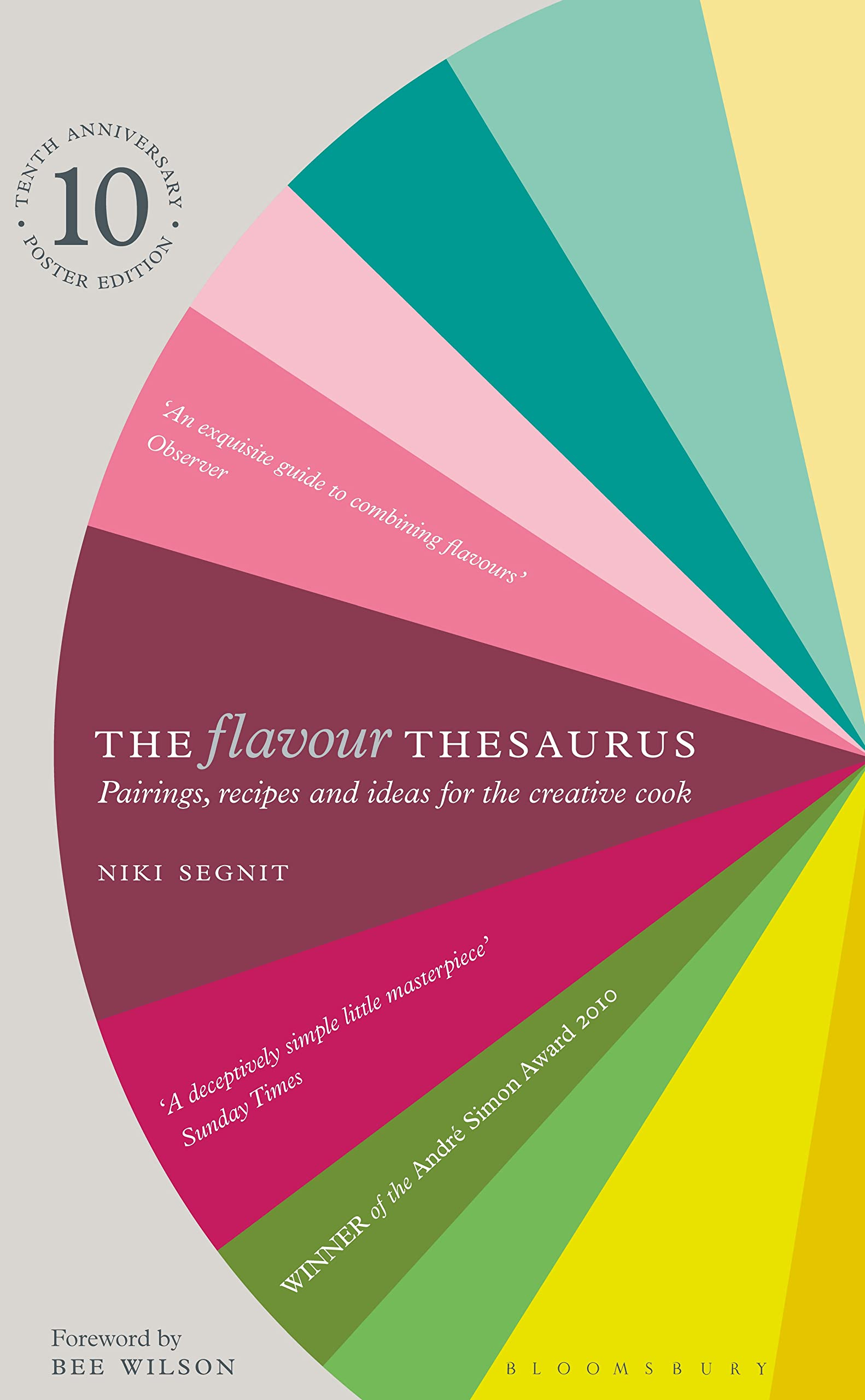
But a few years ago, perhaps in desperation to find anything at all to buy her old dad for Christmas, my daughter bought me Niki Segnit’s The Flavour Thesaurus. I won’t lie: it went straight on the cookery shelves and from there it moved not – until recently when I noticed it and thought I really ought to have a look and play with it. It was a Christmas gift, after all.
The book looks like my kind of thing. The basic premise is one of choosing ingredients you are thinking of mixing together and consulting the compendium to see how well they go together and what kind of flavours to expect. I like that kind of ‘mix and match’ idea for any kind of book really, and if this one leads to new and interesting ideas for cooking, all the better.
The problem is though: it doesn’t.
Fascinating though it is to rummage through the pages for a few minutes, it fails to inspire me and I really can’t see any practical way to actually use it in the kitchen. There’s no recipes and often the references are bloody obvious – like cabbage containing dimethyl sulphide which gives it, well… a cabbagey kind of taste. No shit Sherlock. Furthermore, the sections only ever combine two ingredients together and nothing more. That doesn’t really give you much help when you’re cooking, as a rule, with multiple ingredients.
But there’s another reason why I think this book is, at best, redundant for its purpose. And that reason is probably going to get me some haters.
The reason is this: ChatGPT does the job infinitely better.
Now you can boo and hiss as much as you want. You can remind me that AI is known to hallucinate and could end up giving me cooking instructions that will create the deadliest poison out of a handful of carrots, a tin of tomatoes and a green pepper, its aim to destroy humanity by poisoning the species in the kitchen. I know. I know.
The fact remains though that when I chat to the AI on my phone and tell it what meagre ingredients I’ve got and what kind of flavour I’m after – saucy, sweet, hot, curry-like, something to warm your bones on a cold winter’s night and so on – it comes up with a recipe that doesn’t just work but is actually often ridiculously tasty.
In short, AI is there on your phone and will tell you all about food combinations just as well as Segnit’s book and then actually tell you useful stuff you can then design your evening meal around.
And you can argue with ChatGPT too. If it doesn’t get something quite right, or suggests an ingredient you don’t have, or the type of meal just doesn’t feel right, you can tell it all or any of that and it will try again. You can’t do that with a cookery book. An added bonus is that there’s no fighting with a phone app to keep the pages open without having to put heavy objects on it, or stirring your pot with one elbow on the book, to stop it flopping shut.
Indeed, my feeling is that The Flavour Thesaurus is one of the last of its breed. My cookery book bookcase is going to become a quaint memory of history before too long. Who really needs a cookery book of any sort these days? Even if you are an AI denier (repent, all ye evil humans and bow before your new robot overlords), there’s a good chance you’ve Googled recipes on your phone and swiped through a plethora of them, like you’re on some kind of culinary dating app, until you find the exact one that suits you and your kitchen cupboard and fridge contents just right. AI is simply more interactive and can get you to the perfect meal faster, that’s all. Either way, the days of pulling dusty cookbooks off the shelves are numbered.
I won’t deny that my Australian Women’s Weekly magazine of sauces is going to continue being used on a regular basis – at least monthly if not so much weekly any longer. I’m getting old and I’m a creature of habit. There are cook books like my sauces book that have a special place in my heart and so I will use them out of fondness, if nothing else. I’m sure there may be people who do the same with Segnit’s book but I’m willing to put a small wager on the majority of owners of the book never taking it off their shelf.
Segnit’s book is too little use and too late in coming. For all the accolades it has won over the last sixteen years, this is a living fossil, a relic and a museum piece that will probably only be opened in decades to come by historians intrigued by how people knew how to cook in the days before the human race was enslaved by Terminators.
Either that, or people like my wife will take over the Earth because they have never needed any advice from a book or phone app. Perhaps they will be our new gods, or Jedi knights that will save us? All they’ll need is meat, some veg and some other ingredients for the sauce and slap it all in together. Perfect, and not a cabbage in sight.
My Verdict:

Social Entrepreneur, educationalist, bestselling author and journalist, D K Powell is the author of the bestselling collection of literary short stories “The Old Man on the Beach“. His first book, ‘Sonali’ is a photo-memoir journal of life in Bangladesh and has been highly praised by the Bangladeshi diaspora worldwide. Students learning the Bengali language have also valued the English/Bengali translations on every page. His third book is ‘Try not to Laugh’ and is a guide to memorising, revising and passing exams for students.
Both ‘The Old Man on the Beach’ and ‘Sonali’ are available on Amazon for kindle and paperback. Published by Shopno Sriti Media. The novel,’The Pukur’, was published by Histria Books in 2022.
D K Powell is available to speak at events (see his TEDx talk here) and can be contacted at dkpowell.contact@gmail.com. Alternatively, he is available for one-to-one mentoring and runs a course on the psychology of writing. Listen to his life story in interview with the BBC here.
Ken writes for a number of publications around the world. Past reviewer for Paste magazine, The Doughnut, E2D and United Airways and Lancashire Life magazine. Currently reviews for Northern Arts Review. His reviews have been read more than 7.9 million times.
Get a free trial and 20% off Shortform by clicking here. Shortform is a brilliant tool and comes with my highest recommendation.


Leave a comment