“These stories are for young minds and they provide safe environments for mischief, mayhem and magic…”
I have reached the age where cynicism and sentimentality run hand in hand with each other in my head. I’m a prime candidate for voting Tory (or, these days, Reform) because I want Britain to be the way it used to be again and I hate how people are today. I would do that if I was a complete tw*t, but I think my long-held left-wing socialist values have kept me from going down such dark roads.
But what it does mean is that I prefer reading to actually meeting people these days and I do have a sense of time running out in that respect. I also have fond memories of certain parts of my childhood, not least the children’s books I read in the 70s and 80s, especially the Enid Blyton stories.
The result is that I’ve started raiding my mother’s bookshelves. She’s not young anymore and there’s a realisation for both her and the rest of us in the family that she needs to declutter or we will all have a nightmare when she passes away trying to sort out what’s important and what’s not. Like me, my mother loves collections and so there are many books on her shelves that form whole series – such as more than 100 J.T. Edson Westerns and most of the Agatha Christie novels. I’ve nicked them all, with Mum’s blessing. She won’t read them again, it helps declutter her house and I have both the room and inclination to read them.
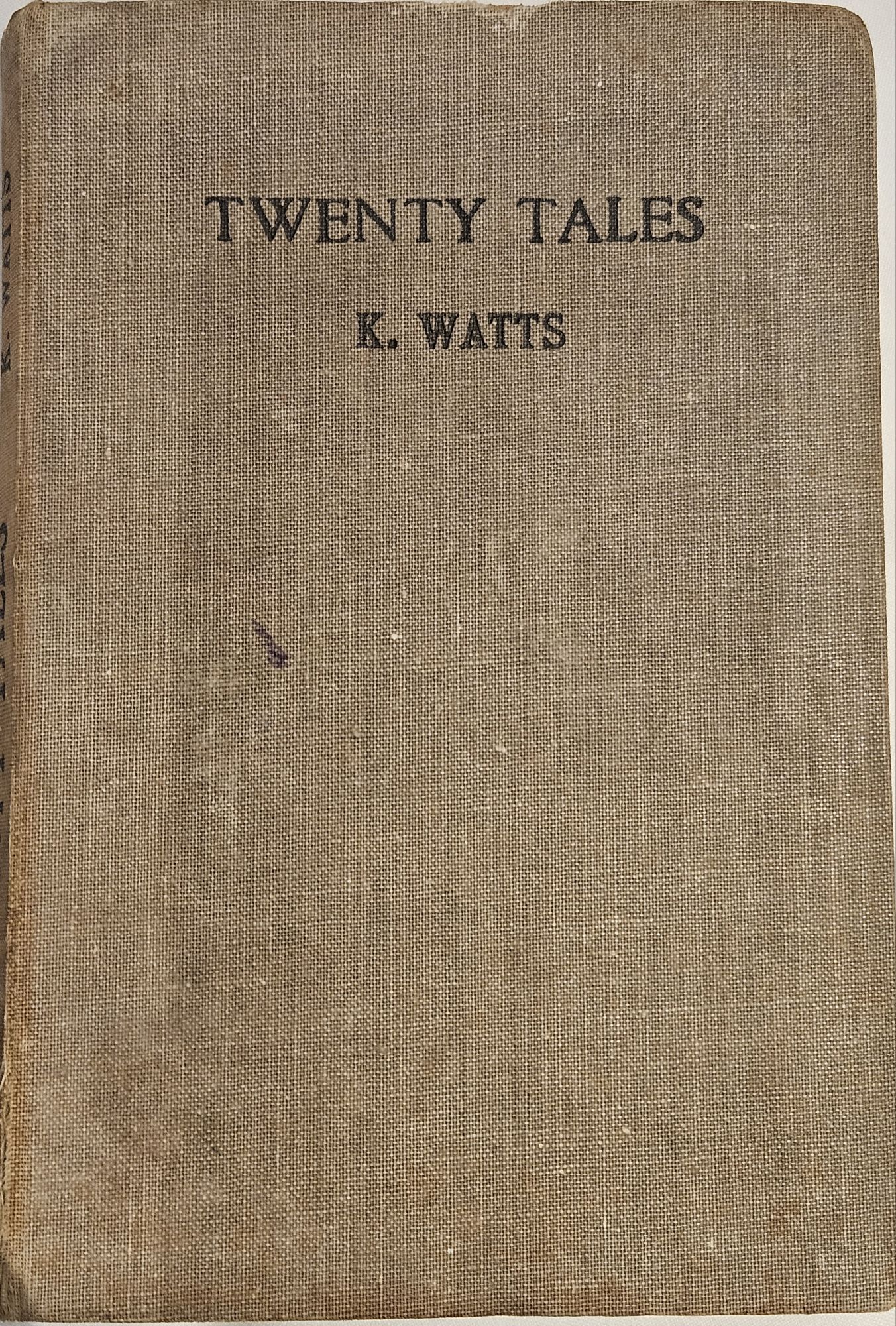
But I’ve also taken books that I had no idea existed on the shelves at all – like Katherine Watts’ Twenty Tales. Exactly what her connection is to our family I’m not entirely sure, and nor is my mother. This copy is signed to my mum (Daphne) and was a Christmas gift in 1950 (when my mum was 10 years old). Katherine signs the book as Mum’s “aunt” suggesting she was an adult friend who would have been known as ‘Aunt’ by children in the family. My parents had family friends – ‘The Finches’, of whom one, Brian Finch, was a very well-known TV script writer – who I had to refer to as Uncle Brian and Auntie Margaret.
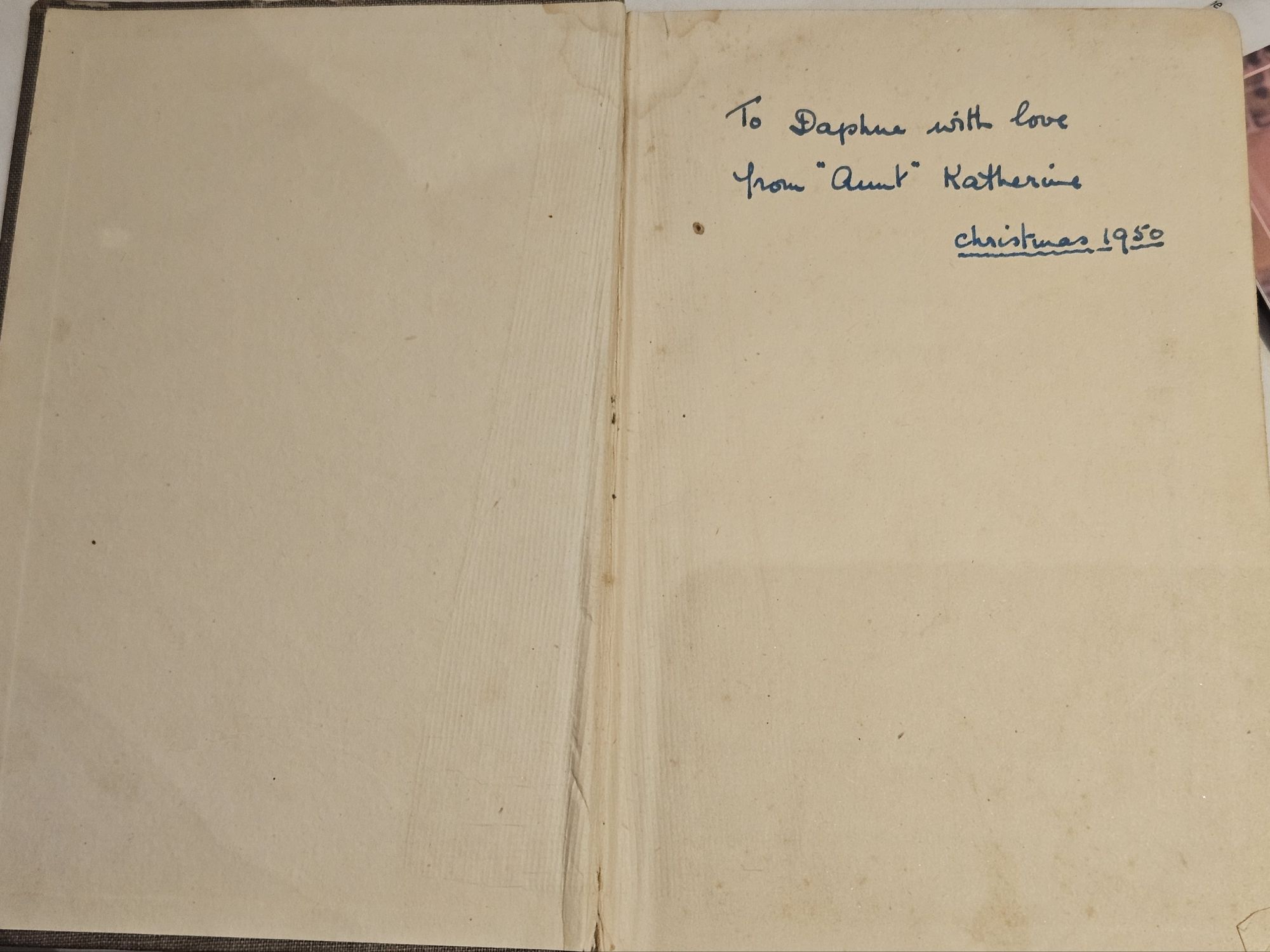
But the surname of Watts is awfully close to my mum’s maiden name of Watt and I find it very hard to believe it is pure coincidence that a Watt and a Watts became friends somehow. What the exact connection is to my family I don’t know and it is possible I’ll never find out.
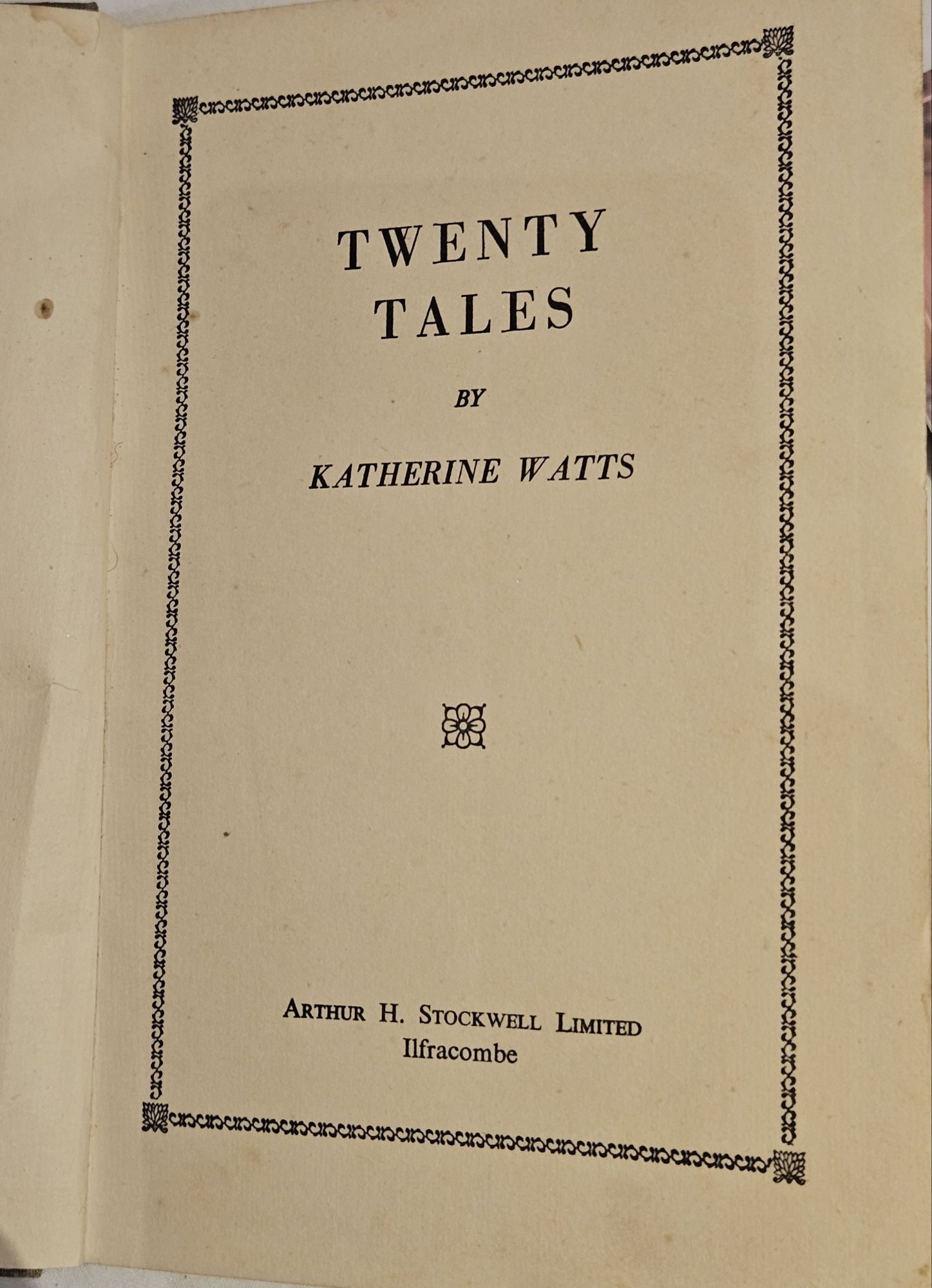
There is very little on the internet to help. The book exists on various internet platforms for sale and appears to have been first published in 1934 by the publishers Arthur H. Stockwell Limited of Ilfracombe (though I can’t confirm the date as there is no printing date in my copy). Other than that, I can find nothing about the author. The publishing company still exists. It was formed in 1898 and became a limited company in 1927, so Katherine’s book would have been published when the company was still relatively new. The aims of the publishing company were to give new authors opportunities to publish and it continues to do this today, though almost all the pages on the company website are 404 error messages – read into that what you wish. Nevertheless, it does look like this was a privately funded book – one we might call vanity publishing today.
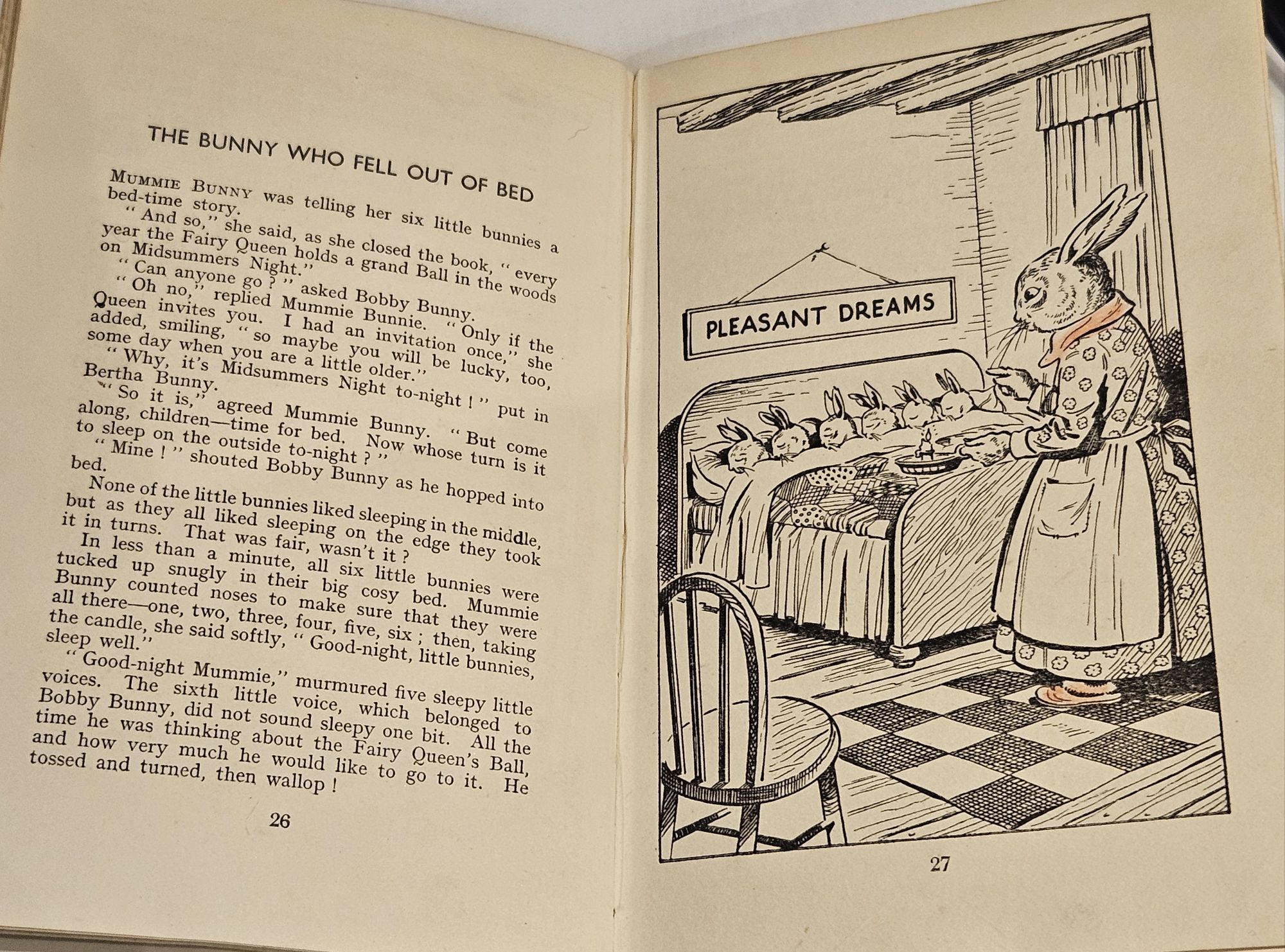
The book itself, as the title suggests, is a collection of twenty short stories for children. It is a world full of pixies, fairies, giants, witches and anthropomorphic bunnies. Many of the stories have illustrations to accompany the text.
The stories themselves have all the feels of Enid Blyton’s books, which is interesting, if the date of 1934 is to be believed, as Blyton’s first full-length book wasn’t published until 1937. She had made a name for herself as a children’s poet in 1922 though and had written many educational books and a few short stories by 1934. Anyway, these stories could easily have been written by Blyton and the illustrations – very much of their time – take me right back to the books I was reading as a child fifty years ago (and those themselves were hand-me-downs rather than new editions).
There is still very much a love-hate relationship with Enid Blyton. I grew up on her books and loved them and accusations of simplicity, second-rate writing and reusing the same plot devices simply miss the point of why her stories were so appealing to children. She created wonderfully simple, loving magical worlds. She’s also accused of racial and sexual prejudice though – something I did not believe until I picked out a book of her short stories and read one to my very young children in the early 2000s. It was the only one I read. I shut the book in horror and never read anything of hers again. It was horrifically prejudiced. Looking back a further twenty-odd years, I maybe have to allow for a writer who lived and worked primarily between the wars and in the last decades of Empire. It doesn’t excuse prejudice, but it does try to understand she was a product of her time.
Katherine Watts’ stories avoid such issues. There’s nothing offensive in any of the stories and you could read these to any small child today without qualms. There’s also little of substance, to be fair, and an older child would be likely to get bored after the first few. But then, it’s horses for courses, isn’t it? These stories are for young minds and they provide safe environments for mischief, mayhem and magic. They won’t be studied at universities – and indeed I suspect this is the only review Twenty Tales will ever have online – but sometimes kids just need comforting entertainment, not highbrow, educationally-stimulating literature. In that sense, this possibly-family-possibly-not author hits the mark.
For me, I was fascinated to read these stories and be reminded of that lovely feeling as a child of snuggling up to a good book, not worrying about quality, thematic progression, or educative value. My daughter is busy cooking up my first grandchild (yes, mine) and I’m thoroughly looking forward to whatever such reading times I can share with them as I get to know them better. There’s a very good chance Twenty Tales might come off the shelf and get a little more use. Not bad for a book that’s over ninety years old.
My Verdict:

Social Entrepreneur, educationalist, bestselling author and journalist, D K Powell is the author of the bestselling collection of literary short stories “The Old Man on the Beach“. His first book, ‘Sonali’ is a photo-memoir journal of life in Bangladesh and has been highly praised by the Bangladeshi diaspora worldwide. Students learning the Bengali language have also valued the English/Bengali translations on every page. His third book is ‘Try not to Laugh’ and is a guide to memorising, revising and passing exams for students.
Both ‘The Old Man on the Beach’ and ‘Sonali’ are available on Amazon for kindle and paperback. Published by Shopno Sriti Media. The novel,’The Pukur’, was published by Histria Books in 2022.
D K Powell is available to speak at events (see his TEDx talk here) and can be contacted at dkpowell.contact@gmail.com. Alternatively, he is available for one-to-one mentoring and runs a course on the psychology of writing. Listen to his life story in interview with the BBC here.
Ken writes for a number of publications around the world. Past reviewer for Paste magazine, The Doughnut, E2D and United Airways and Lancashire Life magazine. Currently reviews for Northern Arts Review. His reviews have been read more than 7.9 million times.
Get a free trial and 20% off Shortform by clicking here. Shortform is a brilliant tool and comes with my highest recommendation.


Leave a Reply