“…gripped my imagination and was truly eye-opening in equal measure…”
They say you should never meet your heroes because you’ll only be disappointed. I’ve never met Mark Forsyth but I certainly do adore his writing and the personality that shines out of his books. Reading a favourite author’s next book is, I guess, the same risk as meeting your hero. If it flops for you, then the fall is all the greater.
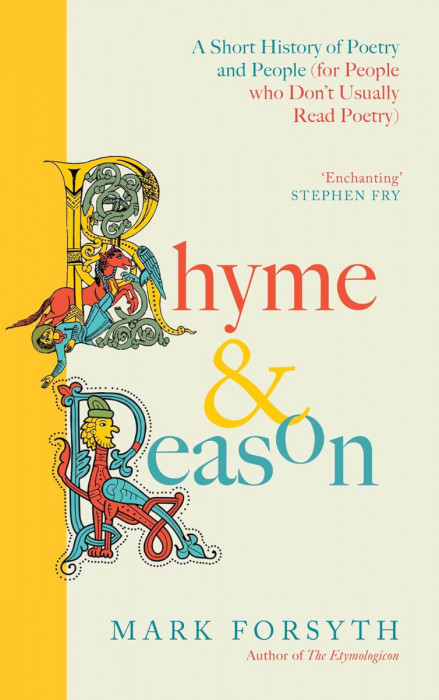
Forsyth’s latest book, which gives an historical account of the writing of poetry and those who read it, is certainly not a flop but I did find myself – for once – disagreeing with major parts of his book, so it was a close call.
I’ve always loved Mark Forsyth’s style. The Horologicon and The Etymologicon were both highly enjoyable and The Elements of Eloquence is virtually my bible and is dipped into on regular occasions, having been read cover to cover more times than any other book I’ve read. I find Forsyth to be informative, witty and just plain nice.
This latest book was bought for me as a birthday gift by my daughter, who knows full well just how much I like this writer, and my TBR pile was immediately swept off the bedside table and replaced by this fascinating short history. It has kept me company for a couple of months, allowing me to read a few pages or a chapter at a time and savour the new knowledge.
From Forsyth we learn a valuable lesson: that poetry was both read and written by ordinary people through the ages and was never intended to be revered and psychoanalysed to the point of death, to the extent that the words no longer mean what they were originally intended to mean. He goes through all the greats with the exception of Shakespeare because, well, let’s face it, The Bard takes over everything, doesn’t he? That said, considering this is a book that deliberately excludes Shakespeare, there’s a wonderfully entertaining and illuminating chapter just on him right at the end as a postscript. Trust Mark Forsyth to make a rule and then break it without breaking it.
I found the whole topic of poetry, seen from the point of view of readers rather than the poets, gripped my imagination and was truly eye-opening in equal measure. It is clear that Forsyth has much love for poetry and how it is meant to be enjoyed. Except, that is, until we reach the twentieth century.
It is in the latter chapters of the book that we reach modern times (post-WWII) and Forsyth is – considering he is a mild-mannered man who, I feel, is kind in all his interactions – scathing, to say the least. He has no time for the English education system deciding that poetry should be analysed rather than ‘enjoyed’ nor does he have any real time for most of the modern poets. For Forsyth, you can just about stretch it to T.S. Eliot and W. H. Auden and then poetry is dead. Indeed his final chapter is a mourning.
I can understand many of his points here and empathise greatly, but I think he is wrong. I say this with conviction as a teacher of English who has been teaching GCSE and A Level students poetry for close to twenty years. I understand that analysing poetry rather than experiencing the feel of poetry has been killing it for young minds for many, many decades, but that doesn’t mean that working out what a poem is saying has no value. It’s essential because we don’t live in the pre-twentieth-century world, where members of your family would stand around the hearth reciting and play-acting great and beloved poems any longer. Thrust Wordsworth in front of a teenager and tell them to just enjoy him and you won’t get the result you might hope for. Indeed, I have worked hard to bring the love of poetry back to students and I do that by presenting poems as puzzles to be solved. The enjoyment comes from that moment when you realise you now get it.
The fact is that the enjoyment of poetry, the way Forsyth wants it to be, has gone. Perhaps, one day, when the robot apocalypse is here and we all disconnect from the internet, we might go back to reciting poetry as we huddle around small fires in the wreck of buildings, hoping the killer drones don’t find us. But until then, this isn’t how we do poetry.
Mark Forsyth actually misses his own point: that poetry was always contemporary and was read in new and novel ways in each era. That’s literally what his book teaches us. We read of new poets each time being all the rage and engaged with in a variety of different ways. It is no different now, though Forsyth dismisses the very nature of the genre today: song lyrics.
Forsyth insists that lyrics read aloud are “dull and lifeless” but I would disagree. He should listen to Sean Connery read The Beatles’ In My Life and try to keep a dry eye. The lyrics to The Beatles’ songs have been published in a single volume several times since their break-up in the early ’70s because so many do enjoy the words for what they say and not just as catchy songs. Likewise, Pink Floyd, Kate Bush, Sting, Radiohead and Queen all have lyrics that are enjoyable in themselves. But even if that wasn’t quite true, the point is that poetry is still enjoyed by millions – it’s just sung by them now, rather than read.
Ironically, the development of pop music into rap means that lyrics genuinely are closer to traditional poetry than ever before and this has led to rap-like performance poets giving poetry recital a comeback. You just have to look at the moving and incredibly talented Sonny Green for proof of that.
So, for the first time, I’m disagreeing with Mark Forsyth’s stance on something – poetry in this case – even if I understand that it comes from good intentions. I have clomped all over his arguments clumsily in this summary and his words deserve to be read for themselves. There’s a good chance you’ll agree more with him than me, especially if you’re over a certain age and have reached the time of life of bemoaning a lost world you probably only knew second hand. That’s fair; Forsyth is a considerably more thought-out kind of writer than I.
And, ultimately, it doesn’t matter. This book is all about enjoying poetry and showing that ordinary people have been doing just that for centuries. Poetry was meant to be devoured and forgotten, to entertain and to bring enjoyment and emotion into people’s lives. Forsyth succeeds brilliantly in this. You will come away with a new appreciation of how a high art today was really just a low art back then and that, perhaps, might have you reaching for dusty collections of poems that you haven’t touched in years.
And if that happens, I suspect Mark Forsyth will be very pleased indeed.
My Verdict:

Social Entrepreneur, educationalist, bestselling author and journalist, D K Powell is the author of the bestselling collection of literary short stories “The Old Man on the Beach“. His first book, ‘Sonali’ is a photo-memoir journal of life in Bangladesh and has been highly praised by the Bangladeshi diaspora worldwide. Students learning the Bengali language have also valued the English/Bengali translations on every page. His third book is ‘Try not to Laugh’ and is a guide to memorising, revising and passing exams for students.
Both ‘The Old Man on the Beach’ and ‘Sonali’ are available on Amazon for kindle and paperback. Published by Shopno Sriti Media. The novel,’The Pukur’, was published by Histria Books in 2022.
D K Powell is available to speak at events (see his TEDx talk here) and can be contacted at dkpowell.contact@gmail.com. Alternatively, he is available for one-to-one mentoring and runs a course on the psychology of writing. Listen to his life story in interview with the BBC here.
Ken writes for a number of publications around the world. Past reviewer for Paste magazine, The Doughnut, E2D and United Airways and Lancashire Life magazine. Currently reviews for Northern Arts Review. His reviews have been read more than 7.9 million times.
Get a free trial and 20% off Shortform by clicking here. Shortform is a brilliant tool and comes with my highest recommendation.


Leave a Reply